
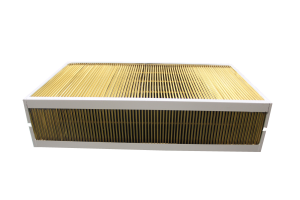
Counter-flow air-to-air heat exchangers are high-efficiency thermal management components designed to transfer heat between two separate air streams without mixing them. By allowing the hot air and cold air to flow in opposite directions, the exchanger maintains a larger temperature difference throughout the heat transfer process, achieving higher efficiency compared with traditional cross-flow designs. Due to their compact structure, reliable performance, and excellent heat transfer capability, counter-flow heat exchangers are widely used in modern cooling and ventilation systems.
In der renewable energy sector, counter-flow heat exchangers are commonly applied in solar inverters, energy storage systems, PCS cabinets, and wind turbine converters. They provide efficient heat dissipation while maintaining a sealed enclosure, preventing dust, moisture, and corrosive air from entering sensitive electrical components. This helps improve equipment reliability, extend component lifetime, and ensure stable operation in outdoor environments.
In der telecommunication and data center industries, counter-flow heat exchangers are used for cooling 5G base stations, communication cabinets, server rooms, and electrical control cabinets. Instead of relying entirely on traditional air conditioning, the heat exchanger transfers internal heat to outdoor air while keeping the two air streams isolated. This reduces cooling energy consumption and provides a safer, more efficient thermal management solution for continuously operating equipment.
Counter-flow air-to-air heat exchangers are also widely applied in HVAC systems, residential ventilation, commercial buildings, and indirect evaporative cooling (IEC) units. By recovering heat from exhaust air and transferring it to incoming fresh air, they help reduce heating and cooling loads while improving overall system efficiency. With advantages such as high efficiency, low pressure drop, and flexible material selection—including aluminum, hydrophilic aluminum, epoxy-coated aluminum, and stainless steel—counter-flow heat exchangers have become an essential solution for energy-efficient cooling and ventilation applications.
Frequently Asked Questions
Where are counter-flow air-to-air heat exchangers used?
They appear wherever two airstreams must exchange heat without mixing: ventilation make-up air, data-center cooling, solar-inverter and energy-storage cabinets, drying tunnels, and cleanrooms. Their compact, high-effectiveness cores suit both HVAC and industrial enclosures.
Why is counter-flow generally more efficient than cross-flow?
In counter-flow the streams move in opposite directions, so a large temperature difference is maintained along the whole plate. Cross-flow streams start parallel and lose driving temperature difference toward the exit, so for the same area counter-flow recovers more energy.
Can a counter-flow core recover both heat and humidity?
A sensible counter-flow core moves temperature only. To recover moisture as well, the plates are made from a selectively permeable membrane or the unit is paired with a desiccant section for total energy recovery.
What should be checked when specifying one?
Review airflow, allowable pressure drop, operating temperature, frost risk in cold supply air, and whether the stream needs to be kept separate for contamination control. These decide plate material, spacing, and core size.
Specify the right heat exchanger
Our engineers size the core to your airflow, temperature and pressure-drop budget, and select plate, rotary or heat-pipe recovery by application. Read the heat exchanger guide or contact us for a specification.
Related products
Plate, wheel or pipe recovery for HVAC and ventilation.
Stationary, high-surface-area cores for air and liquid.
High-effectiveness energy recovery for large airflows.
Passive, fully separated streams for clean applications.