Table of Contents
- Hospitals and pharmaceutical cleanrooms operate under contamination control regimes that simply do not tolerate any uncontrolled leakage between exhaust and supply. The relevant standards include ISO 14644 for cleanrooms, HTM 03-01 in the United Kingdom, NFPA 99 in the United States, and various national pharmaceutical GMP guidelines. The common thread: exhaust air that has contacted patients, biohazardous material, or active pharmaceutical compounds must not re-enter the supply airstream under any operating condition, including single-fan failure or damper failure. A typical hospital isolation room extracts air that has interacted with a patient who may be carrying airborne pathogens. That exhaust air goes to a heat recovery device on the way out. If 1 percent of exhaust leaks into supply, the supply air could carry pathogens into the corridor or into adjacent rooms. In pharmaceutical manufacturing, even trace cross-leakage can ruin a batch or trigger a recall. The procurement specification must rule out any device that cannot demonstrate zero cross-leakage under all operating conditions.
- A high-quality plate heat exchanger, designed with dedicated supply and exhaust channels separated by a continuous aluminum or polymer barrier, achieves effectively zero cross-leakage by construction. There is no rotating surface, no membrane, no fluid loop that could conceivably transfer exhaust air into supply. Pressure cascades (supply slightly higher than exhaust) further ensure that any leak happens in the safe direction (supply to exhaust) rather than the dangerous direction. The downside is that plate exchangers transfer only sensible heat. In applications where the exhaust air is humidity-controlled (operating rooms, pharmaceutical manufacturing), this is fine. In applications where humidity matters (general patient rooms, isolation rooms with humidity setpoints), the lack of latent recovery means the AHU must overcool and reheat supply air to control moisture, which costs operating energy. Sensible efficiency on quality crossflow plate units is 55 to 65 percent. Counterflow plate units can hit 70 to 75 percent sensible efficiency at the cost of larger face area and more complex duct routing.
- A heat pipe bundle is a set of sealed tubes that contain working fluid and transfer heat between two airstreams. Each tube is sealed at the factory; there is no air path between exhaust and supply. This makes the heat pipe bundle equivalent to the plate exchanger from a cross-leakage perspective. Zero transfer of contaminants is structurally impossible. The advantage of heat pipes over a plate exchanger in hospital projects is that the heat pipe bundle can be split into two pieces — one in the exhaust airstream, one in the supply airstream — with the tubes passing through the wall between them. This allows the supply and exhaust ducts to be physically separated by significant distance. It also means that one side can be replaced or serviced without disturbing the other. The disadvantage is moderate efficiency (45 to 60 percent) and the orientation sensitivity covered in our companion article on heat pipe installation.
- A run-around coil loop uses two finned coils — one in exhaust, one in supply — connected by a closed glycol or glycol-water loop. The closed loop cannot transfer air or contaminants between the two streams. As with heat pipes, the supply and exhaust ducts can be separated by arbitrary distance, which is often valuable in retrofit hospital projects. The efficiency is similar to heat pipes (45 to 60 percent), and the cross-leakage is structurally zero. The downside is the operating cost of the circulation pump (USD 60 to 300 per year at industrial tariffs) and the maintenance of the glycol loop. For hospital projects, this is acceptable as a trade for the architectural flexibility and zero cross-leakage.
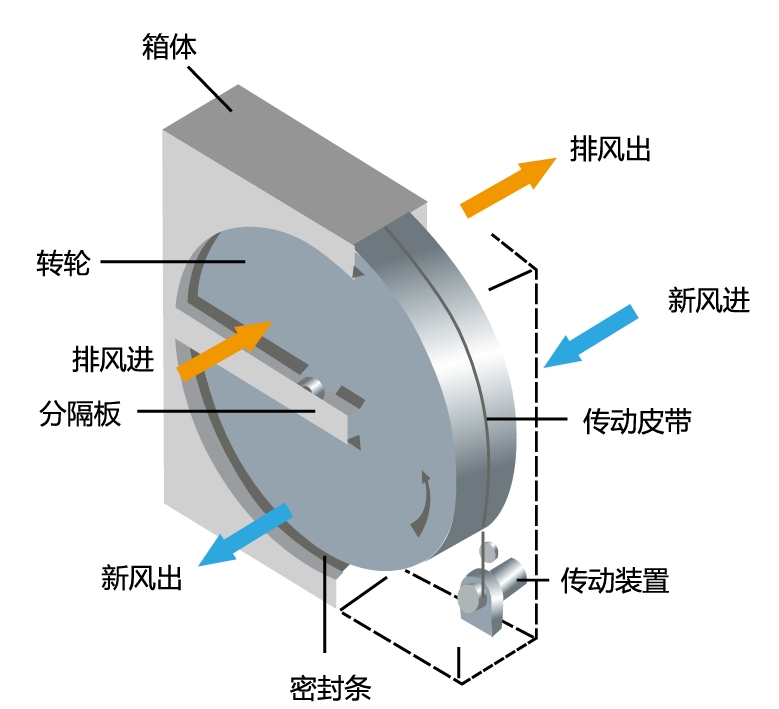
- A rotary enthalpy wheel rotates through both airstreams. The rotor surface is shared between exhaust and supply during rotation. Even with a purge sector, the cross-leakage rate on premium units is 1 to 2 percent; on budget units it can be 3 to 5 percent. This is structurally not zero. Hospital infection control authorities and pharmaceutical QA teams do not accept the cross-leakage from rotary wheels, even with purge sectors. If you propose a rotary wheel on a hospital or pharmaceutical AHU, expect the infection control team to reject the specification and force you to redesign. Choose one of the previous three options.
- Membrane total-energy exchangers transfer both sensible and latent energy through a polymer membrane. The membrane is structurally a continuous barrier; cross-leakage by molecular diffusion is non-zero but small (less than 0.1 percent on quality units). Whether this meets the hospital zero-leakage threshold depends on the infection control authority. Many US hospital standards now accept membrane exchangers; European hospital standards more often do not. Verify with the project infection control consultant before specifying.
- Confirm whether the project requires structurally zero cross-leakage or accepts membrane diffusion. This decision is usually made by the infection control team, not the mechanical engineer. Specify a crossflow or counterflow plate if supply and exhaust can be routed nearby. Specify a heat pipe or run-around coil if the architecture forces separation. Require the manufacturer to demonstrate cross-leakage performance under failure conditions (single-fan failure, damper failure, defrost cycle). Specify a slight supply-side positive pressure relative to exhaust at the plate face. This ensures any leak happens from supply to exhaust, never the reverse. Require factory leak testing on every unit before shipment. Hospital and pharma units are usually tested at 1.5 times design pressure with a hold-and-measure protocol. Document the cleaning protocol. Plate exchangers in hospital projects must be cleaned annually; heat pipe bundles less often. Specify the access panels and removable core dimensions up front.
- Zero-cross-leakage technologies (plate, heat pipe, run-around coil) typically recover 50 to 70 percent of sensible energy. For comparison, a rotary wheel in a non-contaminated application would recover 70 to 85 percent of total energy. The operating cost difference over 15 years is USD 80,000 to USD 200,000 per 10,000 m3/h unit, depending on local energy tariffs. That cost is acceptable in projects where contamination control is mandatory. It is not acceptable in projects where the specifier chose a zero-leakage device simply because they did not consider the rotary option.
- If you are specifying an air handler for a hospital, pharmaceutical, or bio-safety project, default to plate or heat pipe unless the architecture forces separation, in which case run-around coil is the right answer. Reserve rotary wheels for non-contaminated applications: offices, schools, hotels, datacom. Verify the cross-leakage requirement with the infection control team in writing before specifying, not after the bid comes in.
Specifying a heat recovery ventilator for a pharmaceutical cleanroom or hospital isolation suite introduces a constraint that almost no other HVAC project faces: zero tolerance for cross-contamination between exhaust and supply. Whether your project succeeds or fails depends almost entirely on choosing the right exchanger technology and getting the duct routing right. This guide walks through the technology decisions and the validation steps that hospital commissioning engineers actually care about.
Hospitals and pharmaceutical cleanrooms operate under contamination control regimes that simply do not tolerate any uncontrolled leakage between exhaust and supply. The relevant standards include ISO 14644 for cleanrooms, HTM 03-01 in the United Kingdom, NFPA 99 in the United States, and various national pharmaceutical GMP guidelines. The common thread: exhaust air that has contacted patients, biohazardous material, or active pharmaceutical compounds must not re-enter the supply airstream under any operating condition, including single-fan failure or damper failure.
A typical hospital isolation room extracts air that has interacted with a patient who may be carrying airborne pathogens. That exhaust air goes to a heat recovery device on the way out. If 1 percent of exhaust leaks into supply, the supply air could carry pathogens into the corridor or into adjacent rooms. In pharmaceutical manufacturing, even trace cross-leakage can ruin a batch or trigger a recall. The procurement specification must rule out any device that cannot demonstrate zero cross-leakage under all operating conditions.
A high-quality plate heat exchanger, designed with dedicated supply and exhaust channels separated by a continuous aluminum or polymer barrier, achieves effectively zero cross-leakage by construction. There is no rotating surface, no membrane, no fluid loop that could conceivably transfer exhaust air into supply. Pressure cascades (supply slightly higher than exhaust) further ensure that any leak happens in the safe direction (supply to exhaust) rather than the dangerous direction.
The downside is that plate exchangers transfer only sensible heat. In applications where the exhaust air is humidity-controlled (operating rooms, pharmaceutical manufacturing), this is fine. In applications where humidity matters (general patient rooms, isolation rooms with humidity setpoints), the lack of latent recovery means the AHU must overcool and reheat supply air to control moisture, which costs operating energy.
Sensible efficiency on quality crossflow plate units is 55 to 65 percent. Counterflow plate units can hit 70 to 75 percent sensible efficiency at the cost of larger face area and more complex duct routing.
A heat pipe bundle is a set of sealed tubes that contain working fluid and transfer heat between two airstreams. Each tube is sealed at the factory; there is no air path between exhaust and supply. This makes the heat pipe bundle equivalent to the plate exchanger from a cross-leakage perspective. Zero transfer of contaminants is structurally impossible.
The advantage of heat pipes over a plate exchanger in hospital projects is that the heat pipe bundle can be split into two pieces — one in the exhaust airstream, one in the supply airstream — with the tubes passing through the wall between them. This allows the supply and exhaust ducts to be physically separated by significant distance. It also means that one side can be replaced or serviced without disturbing the other.
The disadvantage is moderate efficiency (45 to 60 percent) and the orientation sensitivity covered in our companion article on heat pipe installation.
A run-around coil loop uses two finned coils — one in exhaust, one in supply — connected by a closed glycol or glycol-water loop. The closed loop cannot transfer air or contaminants between the two streams. As with heat pipes, the supply and exhaust ducts can be separated by arbitrary distance, which is often valuable in retrofit hospital projects.
The efficiency is similar to heat pipes (45 to 60 percent), and the cross-leakage is structurally zero. The downside is the operating cost of the circulation pump (USD 60 to 300 per year at industrial tariffs) and the maintenance of the glycol loop. For hospital projects, this is acceptable as a trade for the architectural flexibility and zero cross-leakage.
A rotary enthalpy wheel rotates through both airstreams. The rotor surface is shared between exhaust and supply during rotation. Even with a purge sector, the cross-leakage rate on premium units is 1 to 2 percent; on budget units it can be 3 to 5 percent. This is structurally not zero.
Hospital infection control authorities and pharmaceutical QA teams do not accept the cross-leakage from rotary wheels, even with purge sectors. If you propose a rotary wheel on a hospital or pharmaceutical AHU, expect the infection control team to reject the specification and force you to redesign. Choose one of the previous three options.
Membrane total-energy exchangers transfer both sensible and latent energy through a polymer membrane. The membrane is structurally a continuous barrier; cross-leakage by molecular diffusion is non-zero but small (less than 0.1 percent on quality units). Whether this meets the hospital zero-leakage threshold depends on the infection control authority. Many US hospital standards now accept membrane exchangers; European hospital standards more often do not. Verify with the project infection control consultant before specifying.
- Confirm whether the project requires structurally zero cross-leakage or accepts membrane diffusion. This decision is usually made by the infection control team, not the mechanical engineer.
- Specify a crossflow or counterflow plate if supply and exhaust can be routed nearby. Specify a heat pipe or run-around coil if the architecture forces separation.
- Require the manufacturer to demonstrate cross-leakage performance under failure conditions (single-fan failure, damper failure, defrost cycle).
- Specify a slight supply-side positive pressure relative to exhaust at the plate face. This ensures any leak happens from supply to exhaust, never the reverse.
- Require factory leak testing on every unit before shipment. Hospital and pharma units are usually tested at 1.5 times design pressure with a hold-and-measure protocol.
- Document the cleaning protocol. Plate exchangers in hospital projects must be cleaned annually; heat pipe bundles less often. Specify the access panels and removable core dimensions up front.
Zero-cross-leakage technologies (plate, heat pipe, run-around coil) typically recover 50 to 70 percent of sensible energy. For comparison, a rotary wheel in a non-contaminated application would recover 70 to 85 percent of total energy. The operating cost difference over 15 years is USD 80,000 to USD 200,000 per 10,000 m3/h unit, depending on local energy tariffs. That cost is acceptable in projects where contamination control is mandatory. It is not acceptable in projects where the specifier chose a zero-leakage device simply because they did not consider the rotary option.
If you are specifying an air handler for a hospital, pharmaceutical, or bio-safety project, default to plate or heat pipe unless the architecture forces separation, in which case run-around coil is the right answer. Reserve rotary wheels for non-contaminated applications: offices, schools, hotels, datacom. Verify the cross-leakage requirement with the infection control team in writing before specifying, not after the bid comes in.