MPPS Is Not 0.12 µm, and That Line in Your HEPA Specification Is Wrong
A 2026 trade post has been circulating a requirement along the lines of “99.995% retention at 0.12 µm” for HEPA media. It sounds precise. It is also a category error, and writing it into an acceptance clause will get you a filter that nobody can certify against a method.
What MPPS actually is
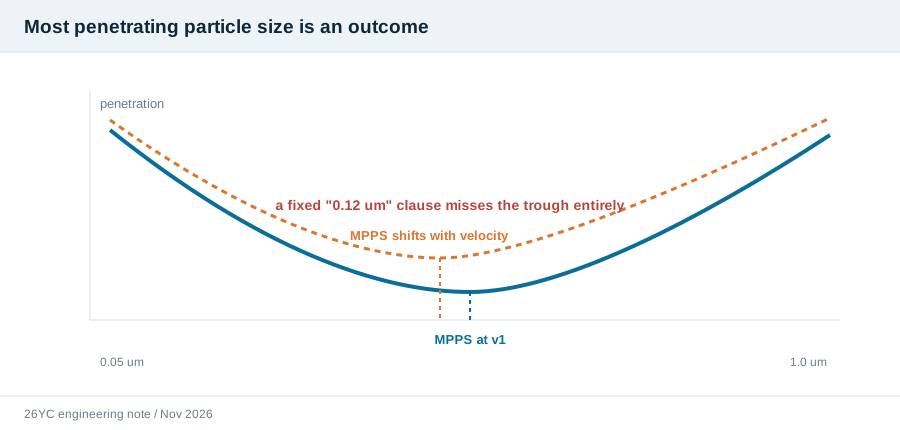
MPPS — most penetrating particle size — is the particle diameter at which a given filter medium, at a given face velocity, is least efficient. It is an outcome, not a fixed constant. For typical glass-fibre HEPA media it sits somewhere around 0.1–0.3 µm, and it shifts with fibre diameter, packing density, charge state and air velocity. Below that size, diffusion capture gets stronger; above it, interception and impaction take over. The curve has a minimum. You find the minimum by testing; you do not define it in a purchase order.
EN 1822 and ISO 29463 build their classification around that minimum: measure penetration across particle sizes, find the worst case, and rate the filter at the MPPS. That is why an H14 filter is specified by its overall and local penetration at MPPS, and why a leak scan of the assembled element is a separate acceptance step. A single-point efficiency at 0.12 µm tells you nothing about a pinhole in the sealant or a damaged pleat.
Our acceptance list for a cleanroom HEPA stage
- Classification to EN 1822 or ISO 29463, with the test laboratory and report number, and the MPPS determined for that medium.
- Local penetration / leak-scan results for the finished element, not just a media coupon.
- Installed leak test (PAO or equivalent) after the filter is in the housing. Most real HEPA failures are installation failures.
- Initial pressure drop at the design airflow, plus a change-out differential. A filter rated at 0.94 m3/s behaves differently at 1.5 m3/s.
- Frame and gasket specification, because the scan in step 3 usually finds the frame.
Step 3 is the one procurement teams skip to save a day on the programme. In a pharmaceutical or semiconductor cleanroom it is the only step that verifies the installed system, and the cleanroom make-up air guide explains how it interacts with the recovery and pressurisation design. Where cross-contamination matters — isolation rooms, fume hoods, pharma exhaust — the core leakage analysis y el zero-cross-leak guide cover the air-side separation that sits upstream of the HEPA stage.
The velocity connection
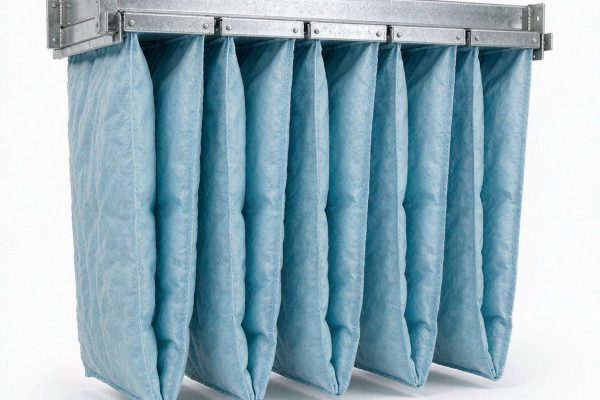
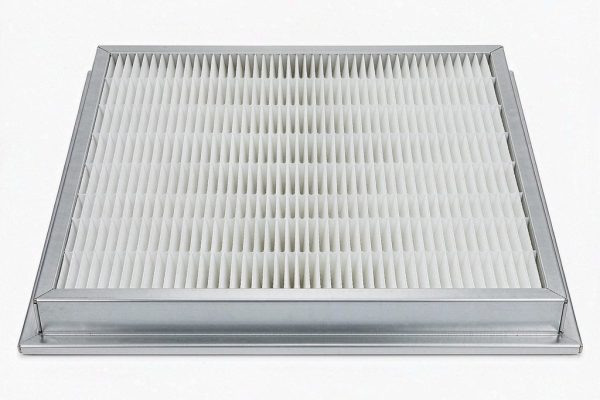
Because MPPS moves with face velocity, the airflow at which the filter was classified belongs in the same clause as the class. That is the same discipline we apply to medium filters in F5-F9 selection and to recovery cores in Velocidad frontal. Our HEPA/ULPA H10-H14 overview lists the construction types — mini-pleat, separator, box — and which ones hold up in low-humidity battery dry rooms, a duty that has grown quickly in 2026.
What to do with the 0.12 µm clause
Delete it. Replace it with the standard, the class, the requirement for the MPPS-derived test report, and an installed leak scan. If the supplier cannot name the test method behind an efficiency figure, that figure is marketing. We take the same view of core effectiveness claims in reading a heat exchanger test report — a number without a method is not a specification.
Especifique el intercambiador adecuado
Nuestros ingenieros dimensionan el núcleo según su caudal, temperatura y presupuesto de caída de presión, y seleccionan recuperación por placa, rotativa o caloduc según la aplicación. Lea la guía del intercambiador , o contáctenos para una especificación.
Productos relacionados
Recuperación por placa, rotativa o caloduc para HVAC y ventilación.
Núcleos estacionarios de gran superficie para aire y líquido.
Recuperación de energía de alta eficacia para grandes caudales.
Corrientes pasivas y totalmente separadas para aplicaciones limpias.