
One Megawatt Is Running in Geneva. The Other 3.2 Are on Paper.
On 5 November we argued that a development agreement fixes a conversation and a heat purchase agreement fixes a buyer. Vaultica’s GEN01 announcement, dated the same week, is neither of those things. It is a plant that is already feeding a network. We should say so plainly, and then add the part that most of the coverage left out: it is feeding about 1 MW, against a project designed for 4.2 MW.
That gap is the interesting number. It is not a shortfall in the plate pack.
Read the release at the level of the pipes
Vaultica says waste heat from GEN01 at Plan-les-Ouates is being supplied to the CADZIPLO low-temperature district heating network, via an exchange station sitting between the data centre and the existing network infrastructure. The chain runs from server cooling to hot water, then through heat pumps and out to the network. The work was developed with Services Industriels de Genève. CADZIPLO is targeting 50 per cent renewable supply, rising to 80 per cent by 2030.
Two figures get quoted, and one of them keeps getting quoted with the wrong denominator. The recovered heat has cut the estate’s heating oil consumption by roughly 45 per cent. That is a statement about the buildings served by the network, not about the data centre’s own electricity bill. We have seen it rewritten as “45 per cent less energy” in at least one summary. It is not. The site still draws whatever the IT load draws, plus the heat pumps.
Work the balance for both phases
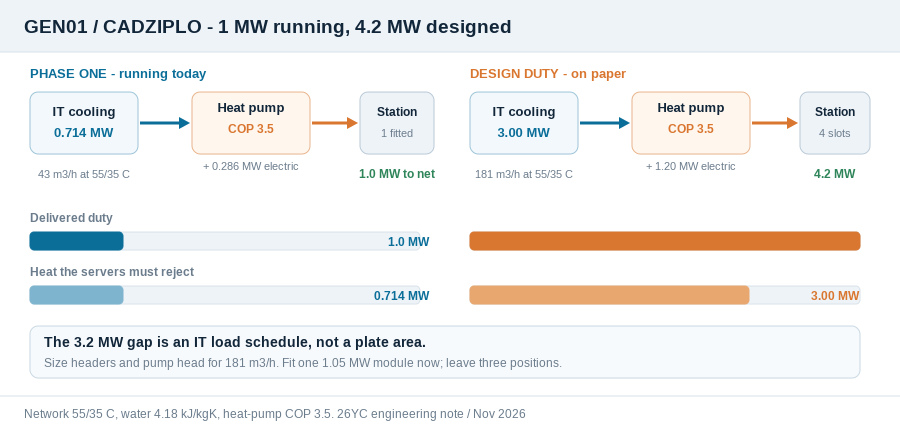
Take a low-temperature network at 55°C supply and 35°C return. With water at 4.18 kJ/kgK, a 20 K spread gives 1,000 / (4.18 x 20) = 11.96 kg/s, about 43 m3/h for 1 MW. At the design duty of 4.2 MW the same spread needs 50.2 kg/s, roughly 181 m3/h. The pipework, the exchange station and the pumps are being sized for a flow four times what is running today.
Now put the heat pumps in. Assume a seasonal COP of 3.5 lifting cooling-loop water at around 30°C up to 55°C network supply. Delivering 1 MW to the network costs 1 / 3.5 = 0.286 MW of electricity, and pulls 1 − 0.286 = 0.714 MW out of the cooling loop. At 4.2 MW those become 1.2 MW of electricity and 3.0 MW of low-grade heat that the servers have to be producing, continuously, at a temperature the evaporator can use.
There it is. To reach 4.2 MW of network supply the IT load has to grow enough to reject about 3 MW into the cooling water. Vaultica says as much in its own wording: as demand at the site grows, the recoverable heat grows with it. The exchanger was never the constraint. We would not quote a 4.2 MW core against a 1 MW heat source, and we would not accept a feasibility study that lists the design duty without the phase-one IT load curve beside it.
Where we would spend the money in phase one
Buy the final-phase interface once: headers, flanges, valve positions, pump head and the space for a second and third plate pack. Then install the heat transfer area in four modules of about 1.05 MW and fit one. A single 4.2 MW pack running at 24 per cent of design flow will see its overall coefficient fall with velocity, and the bypass valve will be hunting near the bottom of its range where it controls badly. Neither is fatal. The real waste is paying for three idle modules and then discovering in year three that the network return temperature changed and the whole pack was specified against the wrong terminal differences.
Modular also means the 2 K hot-end approach can be re-decided when there is a real offtake curve to design against, instead of being frozen into a 2026 purchase order.
The line we would cross out of our own earlier article
We wrote that an MOU is not a buyer. True, but incomplete. A commissioning announcement is not a full-load plant either. Both documents describe a point on a ramp, and the ramp is an IT-load schedule that the equipment supplier rarely gets to see. So the specification should be written in phases: “phase one 1.0 MW delivered, 43 m3/h, four module positions, one fitted.” Not “4.2 MW heat recovery system.”
We have not seen the heat purchase terms for GEN01, and we have not seen a monthly network return-temperature curve. Without those two items this is an interesting operating reference, not a design basis. We keep it in the same file as the two November announcements, one column further along.
What this changes for an air-side enquiry
Very little, and that is worth saying. The heat pumps and the plate station sit on a water loop. The air-to-air recovery job in these buildings is still the residual air-cooled hall fraction, the UPS and battery rooms, and the support spaces. Keep the two loops separate in the specification. If a client asks whether the 4.2 MW figure changes the ventilation core selection, the answer is no — what changes it is the number of hours the heat can actually be absorbed, which is a question for the heat customer, not for the news release.
For anyone modelling the payback on a phased project, run the ROI calculator twice: once at phase-one duty and once at the design duty, with the same core cost in both. The second run is usually the one that flatters the project.
Especifique el intercambiador adecuado
Nuestros ingenieros dimensionan el núcleo según su caudal, temperatura y presupuesto de caída de presión, y seleccionan recuperación por placa, rotativa o caloduc según la aplicación. Lea la guía del intercambiador , o contáctenos para una especificación.
Productos relacionados
Recuperación por placa, rotativa o caloduc para HVAC y ventilación.
Núcleos estacionarios de gran superficie para aire y líquido.
Recuperación de energía de alta eficacia para grandes caudales.
Corrientes pasivas y totalmente separadas para aplicaciones limpias.