
“Not Technically or Economically Feasible”: What That File Actually Has to Contain
Two duties in the recast Energy Efficiency Directive keep getting merged into one. They should not be. Article 12 of Directive (EU) 2023/1791 applies to data centres with at least 500 kW of installed IT power and is a reporting duty — Annex VII information plus the indicator set fixed by Delegated Regulation (EU) 2024/1364, filed annually to the European database. Article 26(6) applies above 1 MW of total rated energy input, a different quantity, and requires the operator to utilise waste heat or apply another recovery measure unless a cost-benefit assessment shows it is not technically or economically feasible.
Reporting is solved with a spreadsheet. The 1 MW duty is solved with a heat customer. Conflating them is how projects end up with a compliant filing and no pipe.
The exemption is where the engineering hides
We have read feasibility assessments that consist of a paragraph and a map with a circle on it. That is not a cost-benefit analysis, and national authorities increasingly treat it as one of the weaker submissions. The file we would sign has five pieces of evidence, all with dates and sources:
| Evidence | Why it decides the outcome | Typical failure |
|---|---|---|
| Annual return-temperature curve of the nearest network | Sets whether a heat pump is needed and how big the lift is | Quoting supply temperature only |
| Route length, civil scope and trenching quotation | Pipe cost is dominated by groundworks, not by the pipe | Using straight-line distance on a map |
| Hours per year the sink can actually absorb heat | Converts a MW figure into bankable MWh | Assuming 8,760 h of offtake |
| Displaced heat source and its carbon / fuel price | Defines the counterfactual for the climate claim | Comparing against nothing |
| Responsibility for interruption and redundancy | Cooling must survive a heat customer going offline | Not mentioned at all |
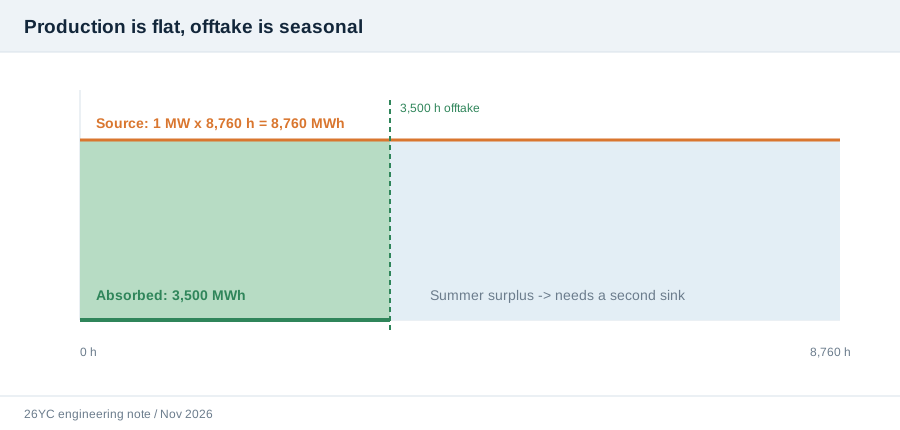
That third row is the one that moves the answer. A 1 MW source running continuously produces 8,760 MWh a year. A heating network that takes heat for 3,500 hours absorbs 3,500 MWh. Utilisation is 40%, before any allowance for part-load or summer curtailment. If the assessment assumes full-year offtake, the payback looks two and a half times better than it is. We have had to redo that calculation for clients who inherited a vendor-supplied study.
Who should write it
Not the exchanger supplier. We sell cores; we have an interest in the pipe being built. Our view is that the operator’s own engineer or an independent consultant should own the assessment, with the network operator providing the temperature and offtake data in writing. A supplier can append equipment quotations and performance curves. If the same company writes the feasibility study and quotes the recovery package, the exemption argument is weak before anyone reads the numbers.
There is also a procurement consequence that gets overlooked. Germany’s national implementation sets phased waste-heat reuse targets for new data centres, and other member states have transposed Article 26 with their own calendars. A project that assumes a single EU-wide deadline will mis-time its tender. Check the national instrument, not the directive summary, and put both the reporting deadline and the national deadline in the project programme as separate lines.
Where air-to-air recovery still fits
Not every site has a district network within economic reach. For a 1 MW facility without one, the honest first move is often internal: use the low-grade heat to preheat make-up air for adjacent production or warehouse space, or to temper a battery room. That is a short pipe, a short contract, and a real offtake for most of the year. Our climate-zone guide to ASHRAE 90.1 6.5.6.1 covers the parallel code question, and the ペイバック(投資回収)計算 is the one we use when the heat customer is a room rather than a utility.
For the temperature and network matching behind all of this, see liquid cooling and immersion waste-heat reuse および data centre recovery guide.
適切な熱交換器を選定
当社のエンジニアが風量、温度、圧力損失の予算に合わせてコアを設計し、用途に応じて板式・回転式・ヒートパイプ回収を選定します。以下をお読みください: 熱交換器ガイド 、または仕様についてお問い合わせください。
関連製品
HVAC および換気向けの板式・回転式・ヒートパイプ回収。
空気と液体用の大表面積固定コア。
大風量向け高効率エネルギー回収。
清浄用途向けの受動的・完全分離流。