
Single-Phase Immersion Won the Retrofit. Here Is Where the Exchanger Goes.
Two-phase immersion had the better physics on paper. It also needed fluorinated dielectric fluids whose supply and regulatory position have been deteriorating for years, with PFAS restrictions and the wind-down of legacy Novec products pushing operators toward simpler loops. In 2026 the practical default for high-density retrofits is direct-to-chip cold plates, with single-phase immersion reserved for the sites that genuinely need maximum density. That shift changes the heat-recovery interface more than most equipment catalogues admit.
The grade of heat, by architecture
| Cooling architecture | Typical rejection temperature | What the recovery loop looks like |
|---|---|---|
| Room air / CRAC | 25–35°C | Air-to-air core on the exhaust, then a large heat-pump lift. Rarely economic for external supply. |
| Rear-door exchanger | 35–45°C water | Marginal grade; usually needs a heat pump. |
| Direct-to-chip cold plate | 45–55°C | Plate exchanger into a secondary water loop, then network or process load. |
| Single-phase immersion | 50–60°C fluid | Best available grade; still belongs behind a plate exchanger, not in an air duct. |
| Two-phase immersion | 50–65°C condensing | Same, plus fluid-handling and vapour-management complexity. |
The pattern is simple: the higher the source temperature, the less electricity the heat pump needs. A 50–60°C source works with a COP in the 3.5–5.0 range for a modest lift into a low-temperature network; a 30°C air stream does not. This is why we stopped describing air-cooled halls as a heat-recovery opportunity in our own proposals. The heat exists. The economics usually do not.
The interface detail that gets drawn wrong
An immersion tank is a sealed dielectric-fluid system with its own materials compatibility, pump skid and service procedure. Putting an air-to-air core anywhere near it solves nothing. What you want is a plate heat exchanger between the dielectric loop and a secondary water loop: it isolates an expensive fluid from a district or process circuit, gives you a clean metering point for the heat purchase agreement, and keeps the server-side warranty boundary intact. On the air side, the only legitimate job is the building’s own ventilation — support rooms, UPS rooms, and any residual air-cooled fraction.
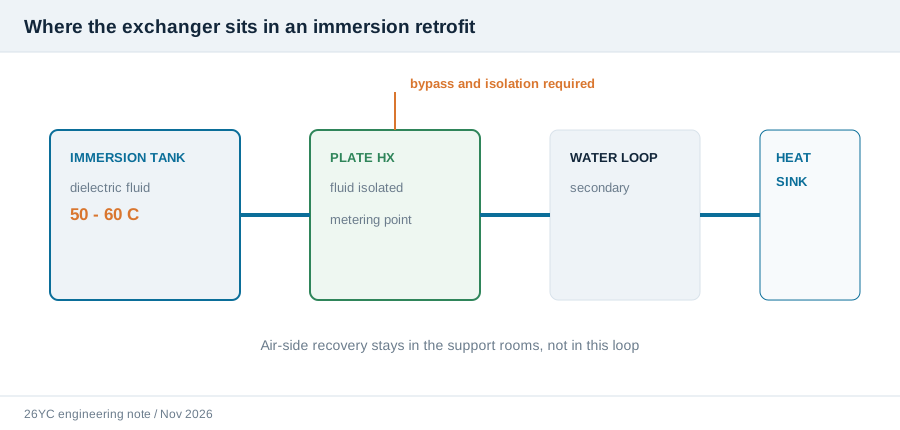
We would also insist on a bypass and isolation valves on that plate exchanger. The IT cooling loop has to keep running when the heat customer stops taking heat — a summer weekend, a network outage, a commissioning delay. A recovery interface that cannot be isolated is a single point of failure for the entire hall. It sounds obvious; we have seen P&IDs where the heat-recovery branch had no bypass.
Selection consequences for the core supplier
Two things follow. First, most of the high-grade duty in these projects is liquid-to-liquid, so a plate exchanger specified for water/glycol service is the relevant product, not a ventilation core. Second, the air-side scope that remains should be specified against the usual air-to-air criteria: airflow, face velocity, pressure drop, leakage and frost margin. Our plate vs rotary vs heat-pipe comparison および plate exchanger working principle cover that side; the liquid-cooling waste-heat guide covers the liquid side.
One opinion we will stand behind: the choice between cold plate and immersion should follow the rack density and the service model, not the heat-reuse ambition. A project that picks immersion mainly because it produces nicer waste-heat temperatures has the decision order backwards. We go through the same logic in BESS thermal management, where the temperature-uniformity requirement, not the recovery opportunity, sets the architecture.
For the temperature matching at the network end, see the data centre recovery guide.
適切な熱交換器を選定
当社のエンジニアが風量、温度、圧力損失の予算に合わせてコアを設計し、用途に応じて板式・回転式・ヒートパイプ回収を選定します。以下をお読みください: 熱交換器ガイド 、または仕様についてお問い合わせください。
関連製品
HVAC および換気向けの板式・回転式・ヒートパイプ回収。
空気と液体用の大表面積固定コア。
大風量向け高効率エネルギー回収。
清浄用途向けの受動的・完全分離流。