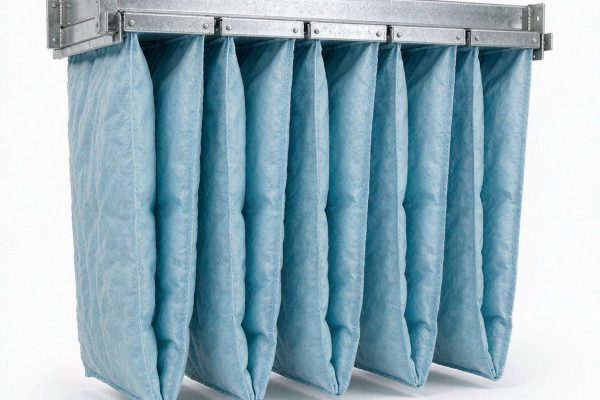
“ePM1 60%” Without an Airflow Is Not a Specification
We asked two suppliers to quote the same medium-filter stage. Both returned “ePM1 60%”. One had tested at 0.94 m3/s, the other at 1.5 m3/s, and neither put the number on the first page of the datasheet. At our design airflow the two filters had different efficiencies, different pressure drops, and different lifetimes. The class matched. The equipment did not.
Three traps in an F-to-ePM rewrite
Trap one: the classes measure different things. The old EN 779 F-grade was a coarse bucket built around average efficiency against synthetic dust at 0.4 µm. ISO 16890’s ePM values are fractional efficiencies against defined PM1 / PM2.5 / PM10 aerosols, with a conditioning step in the test procedure. There is no honest conversion factor. Two “F7-equivalent” products can sit on either side of an ePM1 50% line. Our efficiency-class explainer has the mapping we use, and it is a table of ranges, not a formula.
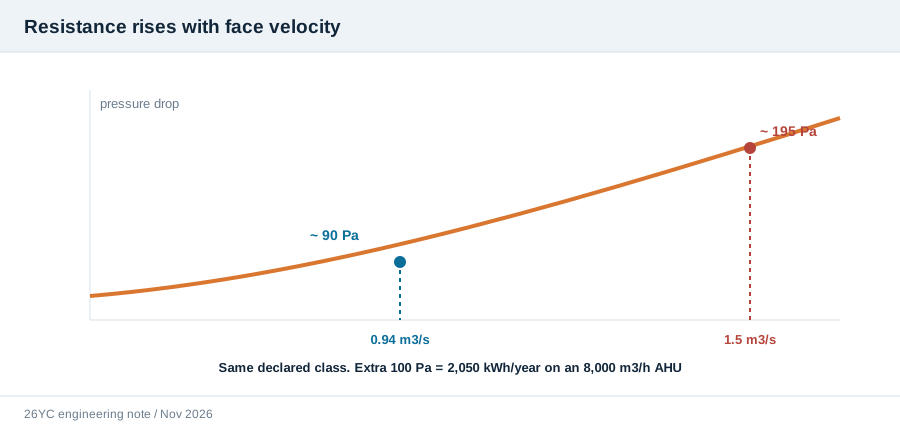
Trap two: the rating airflow is not your airflow. The ISO 16890 test rig uses a nominal 610 x 610 mm face and covers 0.25–1.5 m3/s. At 3,400 m3/h (0.94 m3/s) a single 610 x 610 cell sees about 2.54 m/s. That is within the test range but near its upper end, and it is higher than we like in a commercial AHU. Push the same filter to the top of the range and the resistance rises roughly with velocity to the power of 1.6–1.8 (an empirical range — measure your media). A 90 Pa filter at 0.94 m3/s becomes something like 190–200 Pa at 1.5 m3/s.
Do the fan arithmetic on an 8,000 m3/h unit (2.22 m3/s) at 65% efficiency: an extra 100 Pa costs 2.22 x 100 / 0.65 = 342 W. Over 6,000 hours that is 2,050 kWh a year, every year, because someone specified a class instead of an operating point. The pressure-drop and replacement guide goes further into the maintenance consequences.
Trap three: no terminal pressure drop, no dust-holding capacity. Efficiency at the clean state tells you nothing about how the filter behaves in month five. Ask for the loading curve and the change-out differential; otherwise the “60%” is a photograph of a new filter.
The line we put in the schedule
“Medium filter stage: ePM1 ≥ 60% at 0.94 m3/s per 610 x 610 cell, initial Δp ≤ 90 Pa at that airflow, change-out at 150 Pa, test report attached, frame sealed.” That is four numbers and one document. It is harder to write than “F7” and much harder to mis-supply.
While the second edition of ISO 16890-1 is at the publication stage, we keep the legacy class in brackets beside the ePM value. Our F5-F9 pocket, panel and V-cell selection guide covers the construction choices — V-cell is usually how you buy back face area in a shallow AHU — and the three-stage comparison shows where the medium stage sits relative to the pre-filter and the HEPA stage.
Why this matters more on a heat-recovery unit
A recovery core adds its own 150–200 Pa to the same fan. There is no spare pressure to absorb a filter that was rated at somebody else’s airflow. We size the fan against the sum — filter, core, ducts, dampers — in the AHU 選定計算; 面風速 is the single number that ties the filter and the core together.
If you are rewriting a 2027 specification now, start with the airflow, then pick the class.
適切な熱交換器を選定
当社のエンジニアが風量、温度、圧力損失の予算に合わせてコアを設計し、用途に応じて板式・回転式・ヒートパイプ回収を選定します。以下をお読みください: 熱交換器ガイド 、または仕様についてお問い合わせください。
関連製品
HVAC および換気向けの板式・回転式・ヒートパイプ回収。
空気と液体用の大表面積固定コア。
大風量向け高効率エネルギー回収。
清浄用途向けの受動的・完全分離流。