
A Standards Calendar for 2026, With Two Entries Deliberately Missing
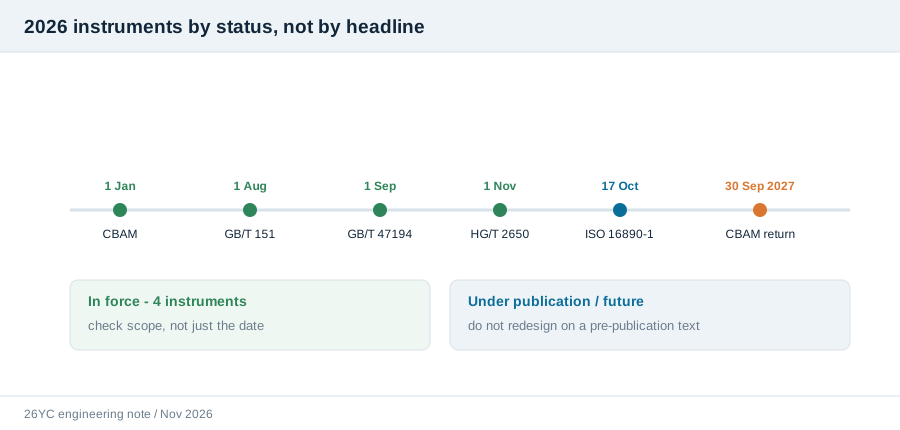
Four months, four standard changes that touch heat exchanger specifications. One of them is routinely applied to the wrong equipment. Rather than write another “2026 compliance guide”, here is the calendar we actually keep, with the status of each item at the time of writing and the one question each change raises for a buyer.
| 日期 | Instrument | Status | What to check in your documents |
|---|---|---|---|
| 1 Jan 2026 | EU CBAM definitive regime, Regulation (EU) 2023/956 as amended | In force; financial obligation applies from the 2026 import year | CN-code-level steel/aluminium mass and verified embedded-emissions data for your EU importer |
| 1 Aug 2026 | GB/T 151-2026 Heat Exchangers | In force, replaces the 2014 edition | Scope: pressure-bearing shell-and-tube, not ventilation recovery cores |
| 1 Sep 2026 | GB/T 47194-2026 Microchannel Heat Exchangers | In force | Does your compact-core datasheet reference the current edition? |
| 1 Nov 2026 | HG/T 2650-2026 Tubular Heat Exchangers | In force, replaces the 2011 edition | Chemical-process tubular units up to 35 MPa; separate line in the spec |
| 17 Oct 2026 | ISO 16890-1 Edition 2 | ISO stage 60.00, under publication; will replace the 2016 edition | Filter schedule: dual-label ePM and legacy class until datasheets are re-rated |
| 2026 editions | UL 9540A / NFPA 855 for stationary storage | Updated editions in use by BESS projects | Thermal-runaway propagation test evidence, separate from normal-operation thermal management |
| 30 Sep 2027 | First CBAM annual declaration for 2026 imports | Future, but the monitoring plan is a present duty | Data retention (at least four years) and an accredited verifier lined up now |
The two entries we did not include
Several 2026 trade pages describe a mandatory 82% sensible recovery efficiency under EN 308 for ERVs entering EU public-building projects, and a 2026 European standard setting a 2°C cell-temperature-uniformity limit for imported liquid-cooled BESS containers. Both claims circulate in nearly identical wording across unrelated domains. We could not open a primary text for either, and in one case the described adoption route does not match how European standards are published.
So they are not in the table. If a customer sends you a tender clause built on one of them, ask for the standard number, the publication date and the issuing body before you design anything around it. Our supplier-claim verification guide has the checklist we use for exactly this situation.
How to use the calendar
A standard changing does not automatically change your product. Ask three questions in order: does the scope cover my equipment; is the text published or still at a pre-publication stage; and has the customer’s tender actually referenced the new edition? In our experience the third question resolves most of the panic. A 2019 edition cited in a signed 2026 contract stays the governing document until the contract is amended, whatever the catalogue says.
There is a second, quieter point. Certification programmes such as AHRI 1060 and Eurovent are voluntary schemes that specifications commonly require; they are not legislation. A standard tells you how a number is measured — see EN 308 与 AHRI 1060 — while a code such as ASHRAE 90.1 or the EU Ecodesign ventilation requirements tells you when recovery is required at all. Keeping those three layers separate is the whole job.
For the air-side core standards specifically, our standards and certifications overview 以及 glossary are the two pages we keep open while reviewing a specification.
相关产品
面向暖通空调与通风的板式、旋转式或热管回收。
空气与液体用大表面积固定芯体。
大风量用高效能量回收。
用于洁净场合的被动、完全分离气流。