
Size the Core for the Peak. Bill the Project for the MWh It Can Actually Absorb.
A feasibility study lands on your desk with a 1 MW recovery duty and a simple payback. The first number is a peak. The second uses it as if it were an average. That single substitution is responsible for more disappointed heat-recovery projects than any equipment fault we have seen.
The duty point is real; the annual energy is not
Take the same interface we use elsewhere on this site: source water 50°C in, 45°C out; network water 35°C return, 45°C delivery. Terminal differences are 5 K and 10 K, so LMTD = (10 – 5) / ln(10 / 5) = 7.21 K. With U = 3,000 W/m2K on a water-to-water plate exchanger, a 1 MW peak needs UA = 139,000 W/K and an area of about 46 m2.
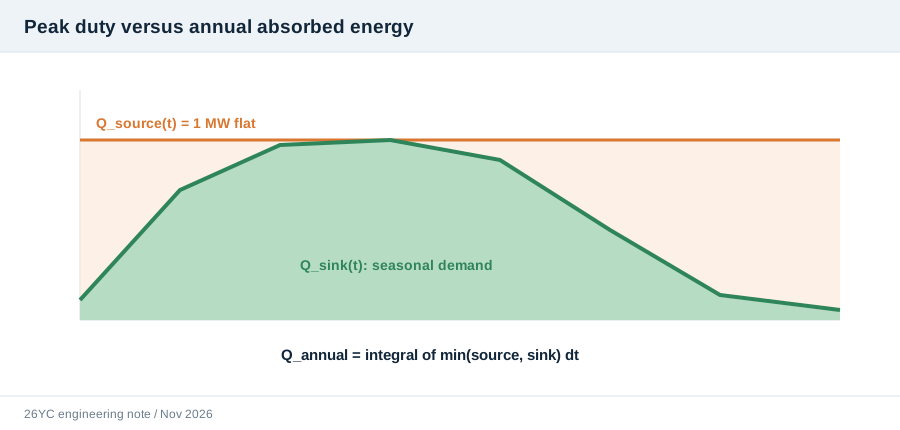
Now the annual ledger. The source runs 8,760 hours at essentially full output: 8,760 MWh available. A heating network with 3,500 hours of absorbable demand takes 3,500 MWh. In compact form:
Qannual = ∫ min( Qsource(t), Qsink(t) ) dt
At €30/MWh for delivered heat, the two ledgers give €263,000 and €105,000 a year. On a €500,000 interface package, that is the difference between a two-year payback and a five-year one. Same plate pack, same pump, same pipe. Only the offtake profile changed.
The wrong conclusion people draw
Someone usually says: then size the exchanger at 40% of peak. Do not. In January the network wants the full megawatt, and an 18 m2 plate pack will not deliver it. The core is sized by the winter peak and the terminal temperature differences at that peak. What changes is the business case, not the heat-transfer area.
If the payback no longer closes, the fix is on the demand side:
- Accept partial utilisation and size for winter peak only. Cheapest first move. The plant still avoids cooling cost in shoulder seasons.
- Add a buffer tank to shift a daily mismatch. Seasonal storage at this scale rarely pays.
- Find a summer sink — an absorption chiller feeding the same campus, a greenhouse, a drying process. This is usually the option that actually moves the annual MWh.
- Negotiate the offtake hours in the heat purchase agreement. A lower price for guaranteed summer offtake can beat a higher winter-only price.
Where the air-side calculation differs
Ventilation cores have a similar trap with a different shape. Their duty is set by airflow and the temperature difference between exhaust and outdoor air, so the peak occurs on the coldest design day — but most of the annual recovered energy happens at part-load, near the seasonal mean. Sizing on the design day and checking savings with the seasonal efficiency rather than the nameplate effectiveness is the equivalent discipline. The ε-NTU method gives you the effectiveness at each operating point; the payback calculation is where we sum them into MWh.
Our rule for the first page of any proposal: state the peak duty, the annual absorbed energy, and the assumed offtake hours, on the same line. If a study gives you only the first, it is a sizing document, not a business case. The ROI calculator lets you change the hours and see the answer move without rebuilding the whole model.
For the temperature and network constraints behind the duty point, start with liquid-cooling waste-heat reuse or the data centre recovery guide.
Specify the right heat exchanger
Our engineers size the core to your airflow, temperature and pressure-drop budget, and select plate, rotary or heat-pipe recovery by application. Read the heat exchanger guide or contact us for a specification.
Related products
Plate, wheel or pipe recovery for HVAC and ventilation.
Stationary, high-surface-area cores for air and liquid.
High-effectiveness energy recovery for large airflows.
Passive, fully separated streams for clean applications.