
Energy Reuse Factor (ERF): Definition, Boundaries, Three Common Mistakes
Energy Reuse Factor is the ratio of energy reused outside a data centre to the total energy consumed by that data centre, reported under the EU Energy Efficiency Directive’s data-centre framework. It appears alongside PUE, WUE and the renewable energy factor in the indicator set that operators above 500 kW installed IT power file annually under Delegated Regulation (EU) 2024/1364.
In plain terms: ERF asks how much of the energy the facility took in came back out as useful heat (or another useful form) instead of being rejected. PUE asks how much overhead the facility added to the IT load. They are different questions, and a site can improve one while the other stands still.
What goes in the numerator and denominator
| Term | Included | Commonly mis-included |
|---|---|---|
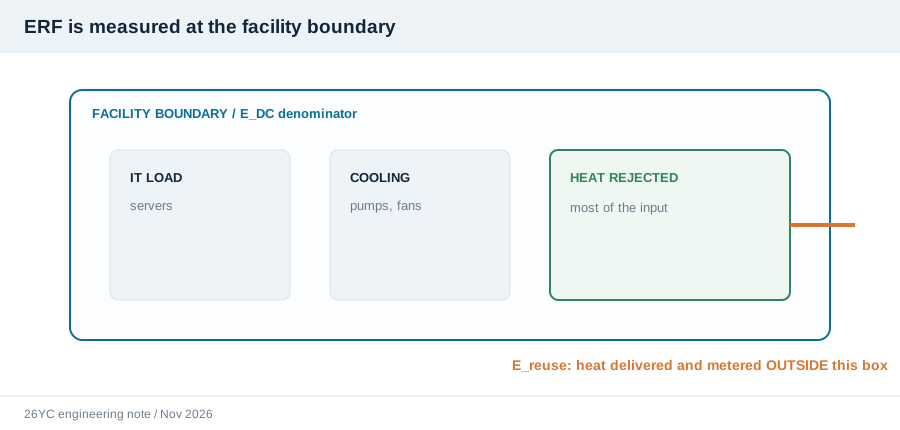
| Ereuse — reused energy | Heat actually delivered to an external user and measured at the point of delivery | Heat that could be recovered; heat used to preheat the data centre’s own intake air |
| EDC — total energy consumption | All energy entering the facility boundary, including cooling, power distribution and auxiliary loads | IT load only; grid connection rating; nameplate capacity |
That first “commonly mis-included” cell causes most of the trouble. Internal heat reuse — tempering your own make-up air, warming a battery room, preheating a domestic hot-water loop inside the same building — is good engineering and often the cheapest first project. It is not energy reused outside the facility in the reporting sense. We have had clients plan an ERF improvement around an internal loop and then discover the filing does not move. Do the internal project anyway; just do not book the metric.
Three mistakes we keep seeing
1. Treating ERF as heat-exchanger effectiveness. Effectiveness (ε) is a dimensionless ratio of actual to maximum heat transfer inside a ε-NTU calculation. ERF is a facility-level energy ratio with a much larger denominator. A core with 80% effectiveness can sit inside a site with a low single-digit reuse factor, because the site has no external heat customer. Nothing is wrong with the core.
2. Comparing a sector-wide reuse observation with a project ERF. In 2026 a number of articles quoted a low single-digit percentage for the share of heat reused across reporting EU data centres. That is an aggregate observation over a reporting population whose data the Commission itself described as incomplete. It is not a threshold, not a target, and not a denominator you can apply to your own site. Germany’s phased national requirements, likewise, are defined over a different population and a different cohort. Do not put them in the same column of a spreadsheet.
3. Ignoring the hours. A facility produces heat 8,760 hours a year. A district network may take it for 3,000–4,500. The numerator is an annual energy quantity, so the offtake profile matters as much as the peak MW. Our calcul de retour sur investissement uses annual MWh for exactly this reason.
Reporting mechanics, briefly
The reporting duty applies from 500 kW of installed IT power, not from average load or grid connection size. Site information and the indicator set are filed by the annual deadline (15 May for the preceding calendar year under the delegated regulation, with national registers in some member states running their own earlier calendar). Individual site values are not published; aggregates are. Operators separately publish the Annex VII information subject to trade-secret carve-outs.
The 1 MW figure people remember belongs to Article 26(6) and is a different quantity — total rated energy input — tied to the duty to utilise waste heat or document why it is infeasible. We wrote that distinction out in full in our data centre waste heat recovery guide; the standards glossary keeps the short definitions.
If you arrived here from a specification: ERF is a reporting outcome. The numbers you can actually specify are delivery temperature, annual offtake hours, and metering at the handover point. Start there.
Spécifiez le bon échangeur
Nos ingénieurs dimensionnent le noyau selon votre débit, température et budget de perte de charge, et choisissent la récupération par plaque, rotative ou caloduc selon l'application. Lisez le guide de l'échangeur , ou contactez-nous pour une spécification.
Produits connexes
Récupération par plaque, rotative ou caloduc pour le CVC et la ventilation.
Noyaux stationnaires à grande surface pour l'air et le liquide.
Récupération d'énergie à haute efficacité pour grands débits.
Courants passifs et totalement séparés pour applications propres.