
The operation mechanism and efficiency analysis of industrial exhaust waste-heat recovery systems is a key link in energy conservation, emission reduction, and improving energy efficiency. The following explains from three aspects: system operation mechanism, core technical composition, and efficiency analysis. 1. Operation Mechanism The basic principle of an industrial exhaust waste-heat recovery system is: transferring […]
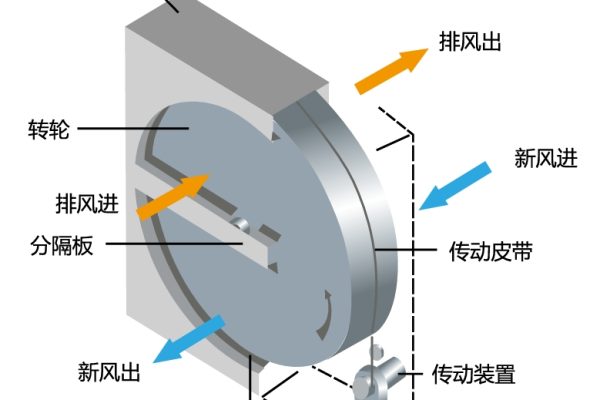
Rotary Exchangers for Large-Airflow Ventilation
Rotary heat-recovery exchangers (also called rotary heat recuperators or heat-recovery wheels) offer multiple advantages in large-airflow ventilation equipment, especially suitable for large buildings, factory workshops, shopping malls, subway stations, and similar places. The following are the core application advantages: 1. High heat-recovery capability The rotary exchanger uses thermal-storage material to form a wheel with high […]
What Is a Good Flow Velocity for an Air-to-Air Heat Exchanger?
The flow velocity selection for an air-to-air heat exchanger depends on the operating conditions, exchanger type, design objectives, and fluid properties. The following are recommendations and typical ranges: Typical flow velocity range Gas velocity: 10–30 m/s. Low velocity (~10 m/s): for pressure-drop-sensitive or energy-saving scenarios. High velocity (~20–30 m/s): for enhanced heat transfer; watch pressure […]
Microchannel Heat Exchanger
The Microchannel Heat Exchanger (MCHE) generally delivers higher heat-transfer efficiency than traditional exchangers (such as shell-and-tube or finned-tube types) thanks to its unique design and structural optimization. The following analyzes the efficiency of microchannel heat exchangers: High heat-transfer area density: Microchannel heat exchangers use tiny channels (typically 0.5–3 mm in diameter), significantly increasing the heat-transfer […]
How to Distinguish the Tube Side and Shell Side of a Heat Exchanger
In a heat exchanger, the tube side and shell side are distinguished by the fluid flow path, mainly based on their structure and working principle. The following is a concise explanation: 1. Tube Side Definition: The path through which fluid flows inside the tube bundle (i.e., inside the tubes) of the heat exchanger. Characteristics: Fluid […]
Core heat exchanger product families
Air-to-Air Heat Exchanger
Récupération par plaque, rotative ou caloduc pour le CVC et la ventilation.
Plate Heat Exchanger
Noyaux stationnaires à grande surface pour l'air et le liquide.
roue de récupération rotative
Récupération d'énergie à haute efficacité pour grands débits.
Heat Pipe Heat Exchanger
Courants passifs et totalement séparés pour applications propres.
Free online tools: Unit Converter · Frost & Condensation Risk Estimator