
Two Heat-Reuse Announcements in One Week. Read the Second One First.
Early November 2026 produced a small cluster of data-centre heat news. On 4 November, atNorth and Calentix signed a project development agreement for heat recovery at the SWE04 site in Sollefteå, Sweden, with the nearby Långsele district network as the intended customer. On 6 November, Spain’s Ignis and Rebi signed a memorandum of understanding to explore district heating networks supplied by data-centre waste heat. Neither announcement means heat is flowing. Both are worth reading, for different reasons.
What the Swedish agreement actually says
The useful details are not in the headline. The project is described as starting around 1.6 MW of recovered heat with potential to scale toward roughly 20 MW as the campus develops; the connection needs between 2 km and 10 km of new pipe; the partners are aiming at a heat purchase agreement in 2027, then a final investment decision, with first heat delivery discussed for 2029. Calentix takes technical, commercial and financial development; atNorth makes surplus heat and site interfaces available.
That last sentence is the interesting one. It puts an independent heat producer between the data centre operator and the network utility. The operator no longer has to become a heat wholesaler to make use of its own exhaust. If this structure survives a final investment decision, it is more significant for the industry than the MW figure.
What the Spanish memorandum says
Less, deliberately. A feasibility assessment, a look at nearby demand, and a division of labour: Rebi operates district networks (six in Spain at the time of writing), Ignis brings the data-centre project portfolio. There is no pipe length, no commissioned capacity and no delivery date. We would not put any number from that announcement into a model. But it is a useful marker: the same “heat customer before cooling design” conversation is now happening outside the Nordic markets that dominated it for a decade.
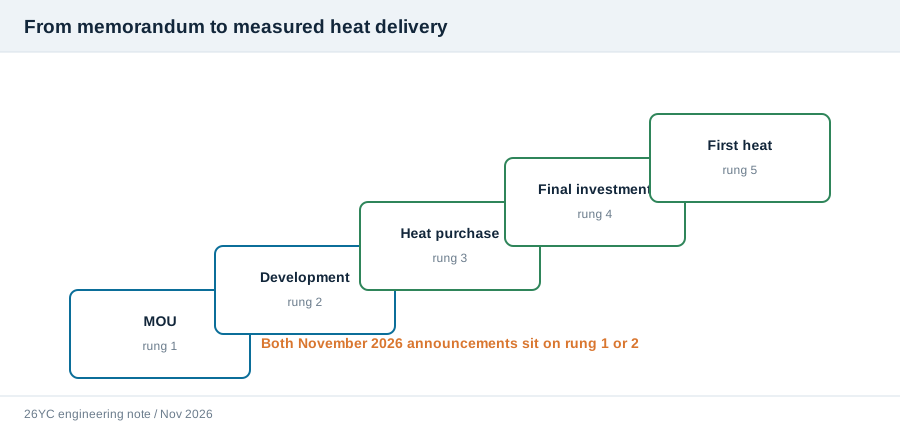
Our reading checklist for the next announcement
When the next press release arrives — and there will be several — these are the four lines we look for:
- Is there a signed heat purchase agreement, or only a development agreement / MOU? The former fixes a buyer; the latter fixes a conversation.
- Who pays for the connecting pipe, and is the route length stated with civil works included? Trenching across a road is a different budget from a straight line on a map.
- What temperature is delivered, and what is the network return? Without both, “recoverable MW” is not a bankable quantity.
- Who carries interruption risk. The data centre’s cooling must keep working if the heat customer stops taking heat in July.
Our broader point: press coverage rewards the biggest number on the page. Engineering decisions should reward the most settled contract. We have watched projects get quietly shelved between a feasibility study and a heat purchase agreement, and no press release marks that step.
What a supplier of air-side equipment should take from this
Very little of the above involves an air-to-air core. The high-grade heat in these projects comes off a liquid loop. The air-side work is in the support spaces, the residual air-cooled halls and, in some designs, the fresh-air tempering that keeps the building’s own heating load down. That is a real market, just not the one the headlines describe. The liquid-cooling waste-heat guide および full data-centre recovery guide separate those two scopes; data-centre support-space recovery covers the part we would actually quote for.
For the regulatory clock behind all this — reporting thresholds, the 1 MW utilisation duty, and national transpositions — see our energy-code summary. Earlier dispatches in this series are collected under Heat Recovery News 2026.
適切な熱交換器を選定
当社のエンジニアが風量、温度、圧力損失の予算に合わせてコアを設計し、用途に応じて板式・回転式・ヒートパイプ回収を選定します。以下をお読みください: 熱交換器ガイド 、または仕様についてお問い合わせください。
関連製品
HVAC および換気向けの板式・回転式・ヒートパイプ回収。
空気と液体用の大表面積固定コア。
大風量向け高効率エネルギー回収。
清浄用途向けの受動的・完全分離流。