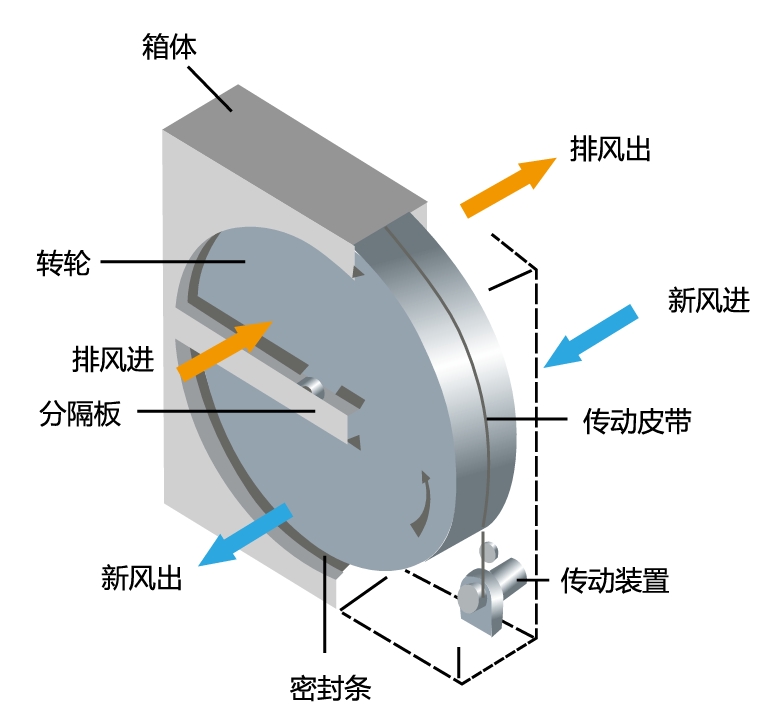
The flow velocity selection for an air-to-air heat exchanger depends on the operating conditions, exchanger type, design objectives, and fluid properties. The following are recommendations and typical ranges:
- Typical flow velocity range
- Gas velocity: 10–30 m/s.
- Low velocity (~10 m/s): for pressure-drop-sensitive or energy-saving scenarios.
- High velocity (~20–30 m/s): for enhanced heat transfer; watch pressure drop and vibration.
- Plate heat exchanger: 5–15 m/s.
- Shell-and-tube exchanger: shell side 1–5 m/s, tube side 10–20 m/s.
- Gas velocity: 10–30 m/s.
- Factors in velocity selection
- Heat-transfer efficiency: Higher velocity enhances turbulence and raises the heat-transfer coefficient, but too high may reduce residence time.
- Pressure drop and energy consumption: High velocity increases pressure drop and power use; a balance is needed.
- Equipment life: Excessively high velocity may cause vibration, noise, or corrosion; too low may cause fouling.
- Flow-channel design: Channel width, length, and layout affect velocity distribution.
- Recommended velocity range
- General recommendation: 8–15 m/s.
- Special cases:
- Energy-saving priority: 5–10 m/s, ensuring turbulence.
- High heat-transfer efficiency: 15–20 m/s, evaluating pressure drop and vibration.
- Design reference: Calculate velocity from heat load (Q = m·Cp·ΔT) and flow rate (Q = V·A).
- How to determine the optimal velocity
- Calculate the Reynolds number: ensure Re > 2100 (Re = ρ·V·D/μ).
- Simulation and testing: Use CFD software or design tools (such as HTRI, Aspen).
- Field adjustment: Adjust valves based on temperature difference and flow rate; observe effects and pressure drop.
- Precautions
- Fluid properties: Density, specific heat, and viscosity affect velocity selection.
- Exchanger material: Sensitive materials require lower velocity.
- Operating conditions: High temperature or corrosive gas requires special control.
- Regular maintenance: Low velocity may cause fouling; cleaning is required.
- Summary It is recommended to control the velocity at 8–15 m/s; the specific value should be determined by calculation or simulation based on exchanger type, fluid properties, heat load, and operating conditions. Use professional software to optimize at the design stage and adjust based on actual operating data to balance heat-transfer efficiency, energy consumption, and equipment life.