
Move the Meter and the PUE Moves With It. A Heat-Reuse Enquiry Should Not Start With a Label.
An EU rating label is coming. The delegated act was adopted on 21 September 2026, Parliament asked for a two-month extension to its scrutiny on 6 October, the ITRE committee discussed it on 10 November, and the first electronic labels are planned for 15 August 2027. A separate consultation on minimum performance standards runs to 14 December 2026. We are already getting enquiries that open with a rating class instead of a temperature.
We send those back. A class is a reporting artefact. Before anybody sizes an exchanger, we need the underlying quantities, and we need to know where each one was metered.
Three places to stand with a meter
CEN/CENELEC EN 50600-4-2 defines three PUE measurement categories in Clause 6.2: category 1 at the output of the UPS feeding IT equipment, category 2 at the output of the power distribution units, category 3 at the input of the IT equipment itself. Same building, three different denominators.
Commission Delegated Regulation (EU) 2024/1364, Annex II, requires category 1 for the European database, with the PDU or category 2 allowed where there is no UPS. The 500 kW reporting threshold applies to installed IT nameplate power, not design capacity; the Commission FAQ issued in September 2026 says that reporting UPS rated capacity instead leads to overestimation. Clause 4 and Annex D of the standard go further and advise against comparing PUE between sites at all, because climate, utilisation, availability class and measurement category all move the number.
That last sentence is the one buyers skip.
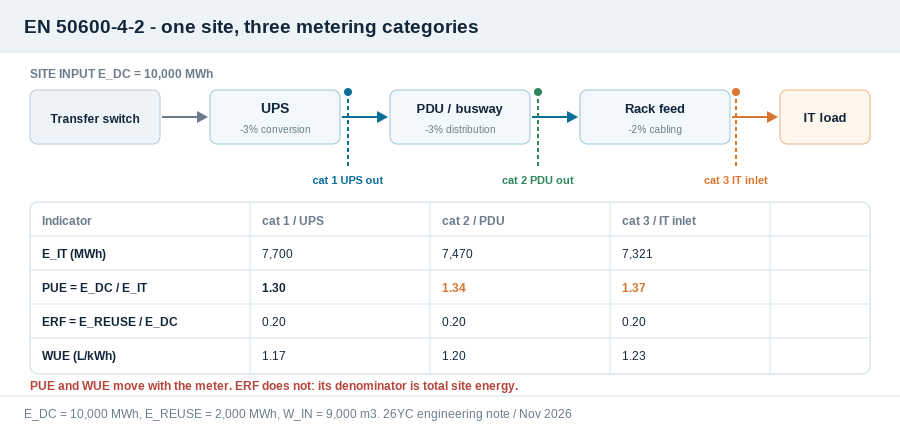
Work one site three times
Take a room with total annual energy EDC = 10,000 MWh, measured at the site input ahead of the transfer switch as the regulation requires. Metering at the UPS output gives EIT = 7,700 MWh. Between that point and the rack inlet sit the PDU transformer, the busway and the rack feeds. Allow 3 per cent to the PDU output and another 2 per cent to the IT inlet, which is ordinary for a legacy room rather than a new one.
| Measurement point | Category | EIT (MWh) | PUE = EDC/EIT |
|---|---|---|---|
| UPS output | 1 (required for EU reporting) | 7,700 | 1.30 |
| PDU output | 2 | 7,470 | 1.34 |
| IT equipment inlet | 3 | 7,321 | 1.37 |
Nothing was replaced. No fan was slowed, no chiller retuned, no server moved. The room went from 1.30 to 1.37 because an engineer stood in a different place. This is why the German EnEfG limits, 1.5 from July 2027 and 1.3 from 2030 for older sites, have to be read together with the measurement basis in DIN EN 50600-4-2. A 0.07 shift is most of the distance between a compliant and a non-compliant year.
Now the part that catches people out. Annex III of 2024/1364 defines ERF as EREUSE / EDC. With 2,000 MWh of heat actually reused, ERF is 0.20 at every one of the three metering positions, because the denominator is total site energy, not IT energy. WUE is the opposite: WIN / EIT with EIT in MWh, so 9,000 m3 of water reads 1.17 L/kWh at category 1 and 1.23 L/kWh at category 3. Two of the three ratios move with the meter. One does not. If a supplier quotes you a single “efficiency score” without saying which indicators sit behind it, there is nothing to check.
The claim we are not putting in a specification
Several industry readings of the September 2026 rating act say it moves the EIT measurement point from the UPS output to the rack connection, with the PDU as fallback. We have not been able to verify that clause against the full official text, the act is still inside procedure 2026/2895(DEA), and the dates depend on it entering into force. So we do not write it. This is the same rule we set out in our editorial note on sources: a plausible reading repeated on four sites is still a reading, not a clause.
There is a second reason to be careful. Reporting to the European database is done with input quantities, and the Commission calculates PUE, WUE, ERF and REF from them. Operators do not submit ratios. The rating layer adds classes and, according to November coverage, a “waste heat reuse readiness” indicator — which is not the same thing as heat that a network actually took. We have defined ERF and its boundary elsewhere; the label is a disclosure of a boundary, not a measurement of a heat exchanger.
Six numbers to ask for before sizing anything
- EDC split by electricity, fuel and cooling, with backup-generator energy reported separately as the regulation asks.
- The EIT measurement category and its physical location, ideally as a monthly kWh series rather than one annual total.
- Where EREUSE is metered under EN 50600-4-6, and whether heat-pump electricity is inside or outside EDC.
- A monthly network return-temperature curve. Not the design value. The hot-end approach comes out of the worst month, not the brochure.
- Annual offtake hours, and who carries the summer surplus. This is what the absorbed-MWh calculation actually depends on.
- The phased IT load curve. Our EED infeasibility note lists the evidence an assessment should carry; the load ramp belongs on that list too.
If items 4 and 5 do not arrive, we do not quote. LMTD, plate area and payback all come out of temperatures and hours, and a rating class supplies neither. The standards calendar tells you when to file; it does not tell you what size to buy.
For the wider chain from server coolant to a network substation, use the data centre waste heat recovery guide, then put your own numbers into the ROI calculator. The calculator asks for hours and temperatures. That is not an accident.
相关产品
面向暖通空调与通风的板式、旋转式或热管回收。
空气与液体用大表面积固定芯体。
大风量用高效能量回收。
用于洁净场合的被动、完全分离气流。