
The hydrophilic aluminum foil plate heat exchanger is designed for boiler exhaust treatment and fresh air system integration, offering a customizable solution for white plume reduction and energy recovery. By applying a hydrophilic coating to aluminum foil plates, the exchanger ensures efficient condensate formation and drainage during air-to-air heat exchange.When hot and humid boiler exhaust […]
Rotary Wheel Heat Exchanger: Efficient Energy Savings, Top Choice for a Green Future!
In the wave of energy conservation and emission reduction, the Rotary Wheel Heat Exchanger stands out as a star product in heat recovery! Developed by professional manufacturers, it offers multiple types including rotary wheel, heat pipe, plate, and liquid circulation exchangers, meeting diverse needs in commercial air conditioning, industrial purification, 5G base stations, medical purification, […]

Heat exchanger manufacturer from China
We are a heat exchanger manufacturer from China, specializing in the production of cross flow and countercurrent heat exchangers, rotary heat exchangers, and heat pipe heat exchangers. We are widely used in boiler flue gas waste heat recovery, heat pump drying waste gas waste heat recovery, food, tobacco, sludge, printing, washing, coating drying waste gas […]
What Are the Advantages of a Heat-Pump Fresh-Air Ventilator?
Advantages of the heat-pump fresh-air ventilator: High energy efficiency: Using heat-pump technology and energy recovery (such as total heat exchange), the coefficient of performance (COP) is typically ≥3.0, recovering heat or cooling from the exhaust air and significantly reducing energy consumption. Multifunction integration: Integrates fresh-air ventilation, cooling, heating, dehumidification, and air purification in one unit, […]
Process Principle and Utilization Methods of Flue-Gas Waste-Heat Recovery in Industrial Painting
In the industrial painting field (such as spraying and drying in automotive, home-appliance, and metal-product industries), the production process generates large amounts of high-temperature organic exhaust and hot air, especially in drying ovens, flash-off ovens, and pre-treatment heating sections, where the flue gas contains substantial waste-heat resources. By recovering this flue-gas waste heat, energy consumption […]
Operation Mechanism and Efficiency Analysis of Industrial Exhaust Waste-Heat Recovery Systems
The operation mechanism and efficiency analysis of industrial exhaust waste-heat recovery systems is a key link in energy conservation, emission reduction, and improving energy efficiency. The following explains from three aspects: system operation mechanism, core technical composition, and efficiency analysis. 1. Operation Mechanism The basic principle of an industrial exhaust waste-heat recovery system is: transferring […]
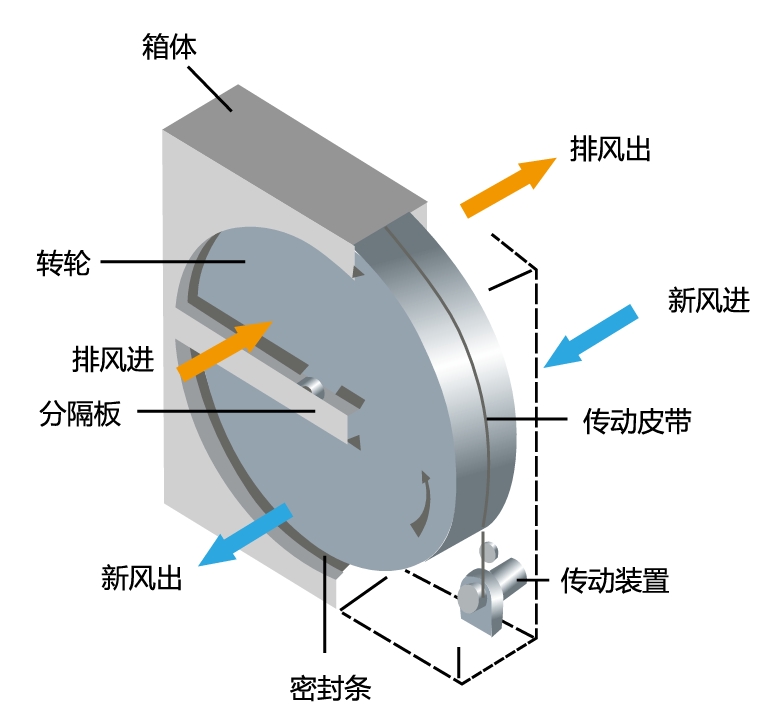
Advantages of Rotary Heat-Recovery Exchangers in Large-Airflow Ventilation Equipment
Rotary heat-recovery exchangers (also called rotary heat recuperators or heat-recovery wheels) offer multiple advantages in large-airflow ventilation equipment, especially suitable for large buildings, factory workshops, shopping malls, subway stations, and similar places. The following are the core application advantages: 1. High heat-recovery capability The rotary exchanger uses thermal-storage material to form a wheel with high […]
Can Meat Microwave Drying Equipment Improve Drying Efficiency?
Meat microwave drying equipment can significantly improve drying efficiency. The main reasons are as follows: Rapid and uniform heating: Microwave technology acts directly on the water molecules in the meat, heating the material inside and out simultaneously. Compared with traditional hot-air drying, microwave drying is faster, and drying time can be shortened severalfold. For example, […]
Mine Exhaust-Air Waste-Heat Utilization and Fresh-Air Heating Scheme
Overview Mine exhaust air refers to the low-temperature hot air discharged from the mine ventilation system. It contains a certain amount of thermal energy and is usually discharged directly, causing energy waste. Exhaust-air waste-heat recovery technology recovers this thermal energy for heating fresh air or other uses, improving energy efficiency while reducing consumption and environmental […]
What Is a Good Flow Velocity for an Air-to-Air Heat Exchanger?
The flow velocity selection for an air-to-air heat exchanger depends on the operating conditions, exchanger type, design objectives, and fluid properties. The following are recommendations and typical ranges: Typical flow velocity range Gas velocity: 10–30 m/s. Low velocity (~10 m/s): for pressure-drop-sensitive or energy-saving scenarios. High velocity (~20–30 m/s): for enhanced heat transfer; watch pressure […]