
This product is a high-efficiency rectangular sensible heat exchange core specially designed for ventilation and cooling of EV charging stations, electrical cabinets, and energy storage enclosures. Featuring a counterflow air-to-air heat exchange structure, it enables effective heat transfer between internal and external air streams while keeping them completely separated, preventing dust, moisture, and contaminants from […]
Customizable Hydrophilic Aluminum Foil Plate Heat Exchanger — Fresh Air Unit for Boiler Exhaust White Plume Reduction
The hydrophilic aluminum foil plate heat exchanger is designed for boiler exhaust treatment and fresh air system integration, offering a customizable solution for white plume reduction and energy recovery. By applying a hydrophilic coating to aluminum foil plates, the exchanger ensures efficient condensate formation and drainage during air-to-air heat exchange.When hot and humid boiler exhaust […]
Process Principle and Utilization Methods of Flue-Gas Waste-Heat Recovery in Industrial Painting
In the industrial painting field (such as spraying and drying in automotive, home-appliance, and metal-product industries), the production process generates large amounts of high-temperature organic exhaust and hot air, especially in drying ovens, flash-off ovens, and pre-treatment heating sections, where the flue gas contains substantial waste-heat resources. By recovering this flue-gas waste heat, energy consumption […]
Operation Mechanism and Efficiency Analysis of Industrial Exhaust Waste-Heat Recovery Systems
The operation mechanism and efficiency analysis of industrial exhaust waste-heat recovery systems is a key link in energy conservation, emission reduction, and improving energy efficiency. The following explains from three aspects: system operation mechanism, core technical composition, and efficiency analysis. 1. Operation Mechanism The basic principle of an industrial exhaust waste-heat recovery system is: transferring […]
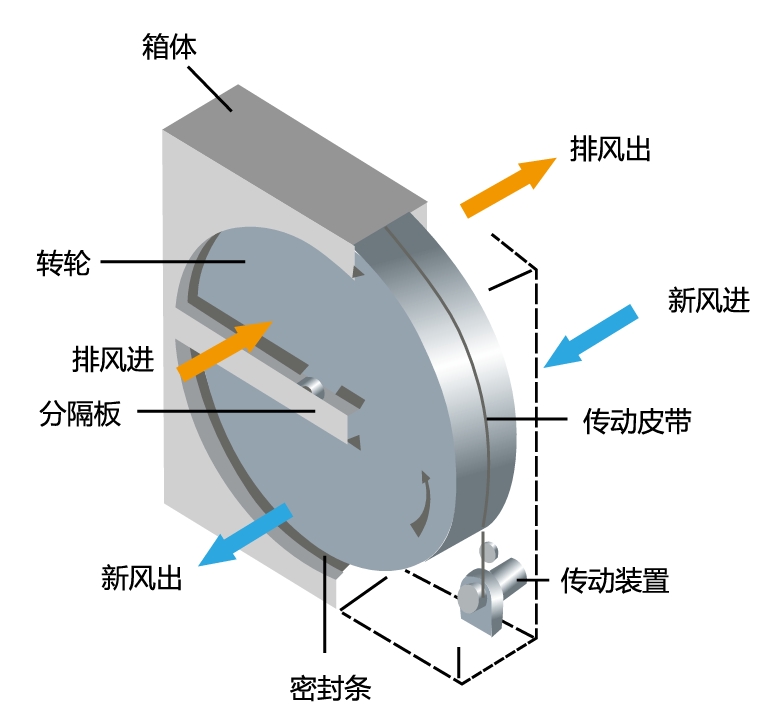
Advantages of Rotary Heat-Recovery Exchangers in Large-Airflow Ventilation Equipment
Rotary heat-recovery exchangers (also called rotary heat recuperators or heat-recovery wheels) offer multiple advantages in large-airflow ventilation equipment, especially suitable for large buildings, factory workshops, shopping malls, subway stations, and similar places. The following are the core application advantages: 1. High heat-recovery capability The rotary exchanger uses thermal-storage material to form a wheel with high […]
What Is a Good Flow Velocity for an Air-to-Air Heat Exchanger?
The flow velocity selection for an air-to-air heat exchanger depends on the operating conditions, exchanger type, design objectives, and fluid properties. The following are recommendations and typical ranges: Typical flow velocity range Gas velocity: 10–30 m/s. Low velocity (~10 m/s): for pressure-drop-sensitive or energy-saving scenarios. High velocity (~20–30 m/s): for enhanced heat transfer; watch pressure […]
Microchannel Heat Exchanger
The Microchannel Heat Exchanger (MCHE) generally delivers higher heat-transfer efficiency than traditional exchangers (such as shell-and-tube or finned-tube types) thanks to its unique design and structural optimization. The following analyzes the efficiency of microchannel heat exchangers: High heat-transfer area density: Microchannel heat exchangers use tiny channels (typically 0.5–3 mm in diameter), significantly increasing the heat-transfer […]
How to Distinguish the Tube Side and Shell Side of a Heat Exchanger
In a heat exchanger, the tube side and shell side are distinguished by the fluid flow path, mainly based on their structure and working principle. The following is a concise explanation: 1. Tube Side Definition: The path through which fluid flows inside the tube bundle (i.e., inside the tubes) of the heat exchanger. Characteristics: Fluid […]