Table of Contents
- Heat exchanger is equipment that transfers heat between two fluids at different temperatures (air-to-air, air-to-liquid, liquid-to-liquid) through a solid wall or direct contact, without mixing them. It is the core component of a heat-recovery system, widely used in HVAC, power, petrochemical, food drying, and new-energy fields.
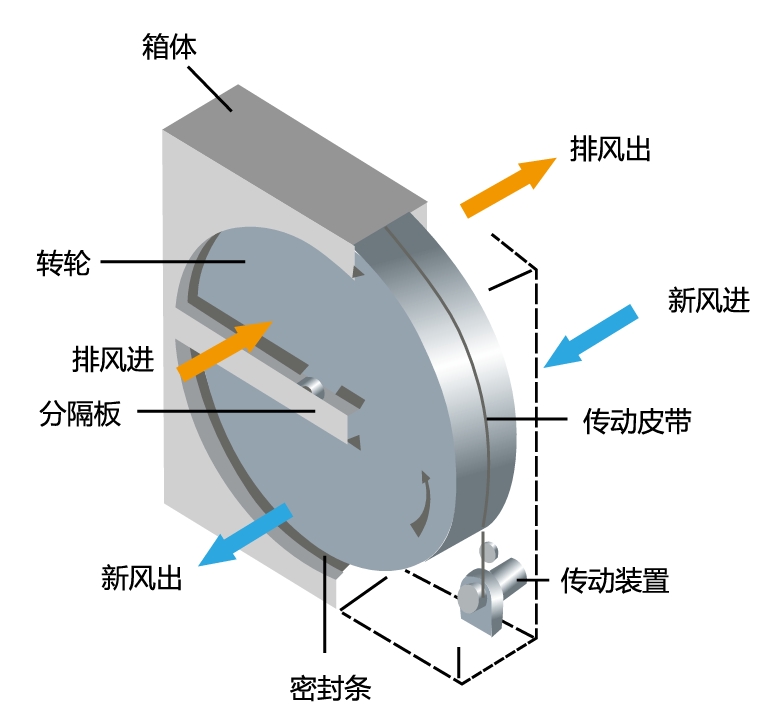
- 1. Plate Heat Exchanger Built from stacked corrugated plates, it offers high efficiency, small footprint, and easy cleaning, suitable for clean fluids. The stainless-steel plate air-to-air exchanger is commonly used for catalytic combustion (CO/RCO) tail-gas waste-heat recovery — see Stainless Steel Plate Air-to-Air Heat Exchanger in CO/RCO Applications. 2. Shell-and-Tube Heat Exchanger Composed of a tube bundle and shell, it is pressure- and temperature-resistant, suitable for large-flow liquid-to-liquid exchange. For its structure, refer to How to Distinguish the Tube Side and Shell Side of a Heat Exchanger. 3. Rotary Heat Exchanger A regenerative wheel rotates continuously, recovering both sensible and latent heat, suitable for large-airflow, high-humidity exhaust; commonly used in fresh-air systems — see Advantages of Rotary Heat-Recovery Exchangers in Large-Airflow Ventilation. 4. Air-to-Air Heat Exchanger Dedicated to exhaust-to-fresh-air exchange; airflow velocity is a key parameter in selection — refer to What Is a Good Flow Velocity for an Air-to-Air Heat Exchanger?. 5. Microchannel Heat Exchanger Flat-tube multi-channel structure, compact and efficient, suitable for refrigeration and precise temperature control — see Microchannel Heat Exchanger.
- Fluid properties: Clean gas → plate or rotary; dusty or corrosive flue gas → heat-pipe or stainless-steel anti-corrosion type. Temperature and pressure: High temperature and pressure → prefer shell-and-tube. Whether humidity recovery is needed: For dehumidification → total-heat rotary. Space constraints: Tight site → plate or microchannel.
- A heat exchanger alone only transfers heat; combined with fans, temperature/humidity sensors, and a control system does it form a complete heat-recovery solution. It is recommended to first clarify the recovery goal (preheat fresh air / heat process water / dehumidify), then back-calculate the exchanger type and area, avoiding "over-specification" or insufficient efficiency.
- Regularly check plates for fouling and clogging; circulate a neutral cleaner for flushing. For rotary types, watch seal wear and motor lubrication. In low-temperature winter conditions, provide freeze protection and condensate drainage.
- Q: Which is more efficient, plate or shell-and-tube?A: Under the same conditions, plate has stronger turbulence and a higher heat-transfer coefficient, but shell-and-tube has a wider pressure/temperature range. Q: What is the typical efficiency of an air-to-air exchanger?A: With reasonable design it can reach 60%–80%, depending on the airflow ratio and temperature difference. For more products and solutions, browse the heat-exchanger product category.
Heat exchanger is equipment that transfers heat between two fluids at different temperatures (air-to-air, air-to-liquid, liquid-to-liquid) through a solid wall or direct contact, without mixing them. It is the core component of a heat-recovery system, widely used in HVAC, power, petrochemical, food drying, and new-energy fields.
1. Plate Heat Exchanger
Built from stacked corrugated plates, it offers high efficiency, small footprint, and easy cleaning, suitable for clean fluids. The stainless-steel plate air-to-air exchanger is commonly used for catalytic combustion (CO/RCO) tail-gas waste-heat recovery — see Stainless Steel Plate Air-to-Air Heat Exchanger in CO/RCO Applications.
2. Shell-and-Tube Heat Exchanger
Composed of a tube bundle and shell, it is pressure- and temperature-resistant, suitable for large-flow liquid-to-liquid exchange. For its structure, refer to How to Distinguish the Tube Side and Shell Side of a Heat Exchanger.
3. Rotary Heat Exchanger
A regenerative wheel rotates continuously, recovering both sensible and latent heat, suitable for large-airflow, high-humidity exhaust; commonly used in fresh-air systems — see Advantages of Rotary Heat-Recovery Exchangers in Large-Airflow Ventilation.
4. Air-to-Air Heat Exchanger
Dedicated to exhaust-to-fresh-air exchange; airflow velocity is a key parameter in selection — refer to What Is a Good Flow Velocity for an Air-to-Air Heat Exchanger?.
5. Microchannel Heat Exchanger
Flat-tube multi-channel structure, compact and efficient, suitable for refrigeration and precise temperature control — see Microchannel Heat Exchanger.
- Fluid properties: Clean gas → plate or rotary; dusty or corrosive flue gas → heat-pipe or stainless-steel anti-corrosion type.
- Temperature and pressure: High temperature and pressure → prefer shell-and-tube.
- Whether humidity recovery is needed: For dehumidification → total-heat rotary.
- Space constraints: Tight site → plate or microchannel.
A heat exchanger alone only transfers heat; combined with fans, temperature/humidity sensors, and a control system does it form a complete heat-recovery solution. It is recommended to first clarify the recovery goal (preheat fresh air / heat process water / dehumidify), then back-calculate the exchanger type and area, avoiding "over-specification" or insufficient efficiency.
- Regularly check plates for fouling and clogging; circulate a neutral cleaner for flushing.
- For rotary types, watch seal wear and motor lubrication.
- In low-temperature winter conditions, provide freeze protection and condensate drainage.
Q: Which is more efficient, plate or shell-and-tube?
A: Under the same conditions, plate has stronger turbulence and a higher heat-transfer coefficient, but shell-and-tube has a wider pressure/temperature range.
Q: What is the typical efficiency of an air-to-air exchanger?
A: With reasonable design it can reach 60%–80%, depending on the airflow ratio and temperature difference.
For more products and solutions, browse the heat-exchanger product category.