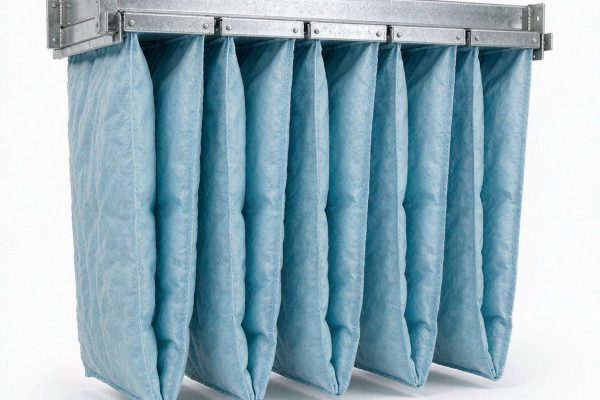
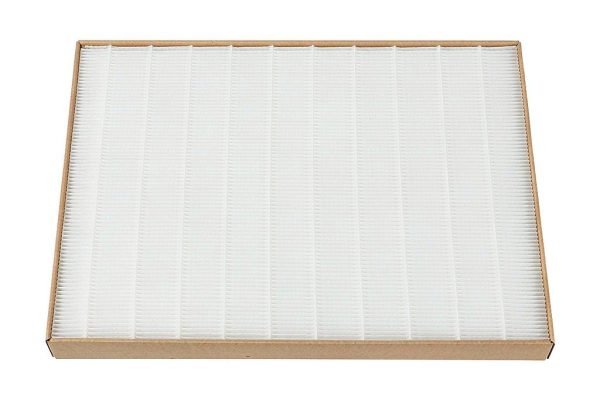
From EN 779 to ISO 16890
For years Europe used EN 779, which split filters into coarse classes G1-G4 and fine classes F5-F9, plus HEPA H classes under EN 1822. Since 2018, ISO 16890 reports efficiency against defined particle sizes (ePM1, ePM2.5, ePM10, Coarse), which maps closely onto the old letter bands.
Coarse / Primary – G1 to G4
| Class | Average arrestance | Typical use |
|---|---|---|
| G1 | ≤ 65% | Pre-filter, coarse dust |
| G2 | 65-80% | General ventilation pre-filter |
| G3 | 80-90% | Make-up air, paint booths |
| G4 | ≥ 90% | Standard HVAC pre-filter |
Fine / Medium – F5 to F9
| Class | ISO 16890 band | Typical use |
|---|---|---|
| F5 | ePM10 50% | Commercial HVAC final / pre-HEPA |
| F6 | ePM10 60-80% | Schools, offices |
| F7 | ePM2.5 50-70% | Hospitals, labs, food |
| F8 | ePM2.5 70-90% | Pharma, clean support |
| F9 | ePM1 ≥ 90% | Pre-HEPA, critical HVAC |
HEPA / ULPA – H10 to H14, U15 to U17
EN 1822 rates HEPA/ULPA by efficiency at the Most Penetrating Particle Size (MPPS, ~0.1-0.3 µm):
| Class | MPPS efficiency | Use |
|---|---|---|
| H10 | 85% | Clean workstations |
| H11 | 95% | Cleanrooms ISO 7-8 |
| H12 | 99.5% | Cleanrooms ISO 6 |
| H13 | 99.95% | ORs, ISO 5, aseptic |
| H14 | 99.995% | ISO 5, critical aseptic |
| U15-U17 | 99.9995%+ (≥0.12 µm) | ULPA, ISO 3-4 |
Which Label Do You Read?
Specify by the band your standard requires. If a tender cites ISO 16890, ask for ePM1/ePM2.5/ePM10 percentages; if it cites EN 779/EN 1822, use the G/F/H letters above.
Specifying the right filter class is only half the task; the other half is matching the rating method to how your system is procured and commissioned. Since ISO 16890 replaced EN 779 in 2018, many new tenders ask for efficiency expressed as ePM1, ePM2.5 or ePM10 percentages rather than the older G and F letters. In practice the two systems describe the same media, so a filter sold as F7 will usually fall in the ePM2.5 50-70 percent band. For HEPA and ULPA, EN 1822 and ISO 29463 remain the reference and rate devices at the most penetrating particle size, which is why a single efficiency figure alone can be misleading. When comparing quotations, always ask suppliers to state the test standard, the particle size band, and the final pressure drop, so that selections are comparable and the installed performance matches the design intent.
Frequently Asked Questions
What replaced the old EN 779 standard?
ISO 16890, adopted in 2018, reports filter efficiency against defined particle size bands ePM1, ePM2.5, ePM10 and Coarse, and it maps closely onto the previous G and F letter classes.
How do ISO 16890 bands relate to the old G and F classes?
They describe the same media using particle size rather than letters; for example an F7 typically sits in the ePM2.5 50-70 percent band and an F9 approaches ePM1 90 percent or higher.
What does MPPS mean on a HEPA label?
MPPS is the most penetrating particle size, roughly 0.1 to 0.3 micrometres, at which EN 1822 and ISO 29463 rate HEPA and ULPA efficiency.
Which label should I specify in a tender?
Match the standard your specification cites: ask for ePM percentages when ISO 16890 is referenced, and use the G, F and H letters when EN 779 or EN 1822 is referenced.