Start With a Stage Strategy
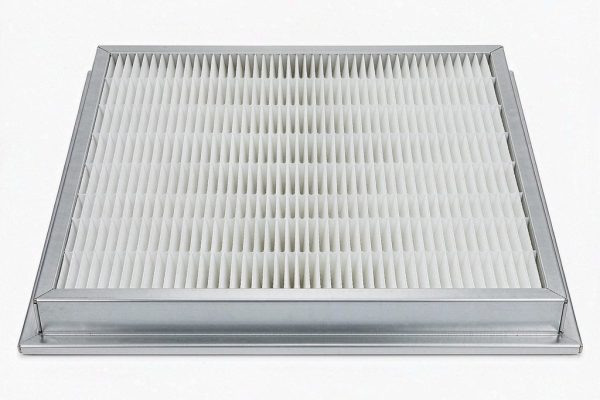
Most systems run two stages: a cheap primary filter protects a finer final filter, cutting total cost. Clean spaces add a third (HEPA) stage.
Typical Arrangements by Space
| Space / industry | Recommended stages | Notes |
|---|---|---|
| Offices, schools, retail | G4 pre + F7 final | Comfort, moderate IAQ |
| Commercial HVAC (better IAQ) | G4 + F8/F9 | Asthma/allergy, urban |
| Hospital wards | G4 + F8 | Infection control |
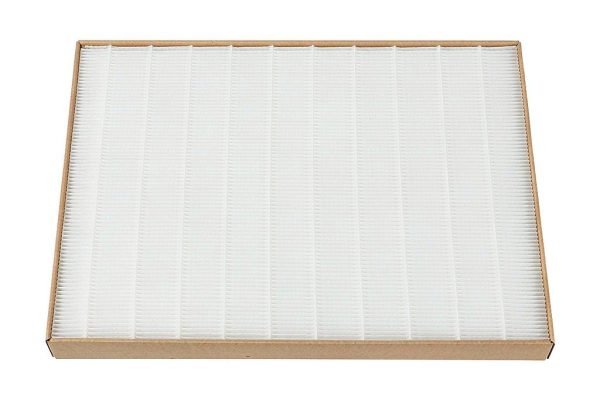
| Operating theatres / isolation | G4 + F9 + H13/H14 terminal | ISO 5, laminar |
| Pharma / aseptic | G4 + F8 + H13/H14 | ISO clean |
| Microelectronics cleanroom | G4 + F9 + H14 (+ U15) | Sub-micron control |
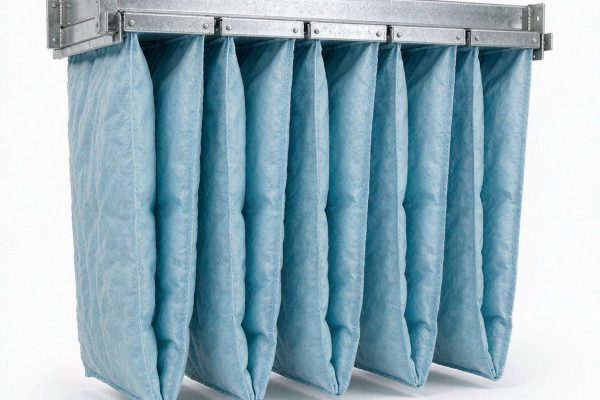
| Paint / spray booths | G3/G4 panel + F5-F7 pocket + carbon | Overspray + odour |
| Data centres | G4 pre + F9 final | Low ΔP priority |
| Food & beverage | G4 + F7/F8 | Hygiene, washable frames |
| Compressor / turbine intake | G3/G4 + F6 pocket | Equipment protection |
Quick Rules of Thumb
- Dirty, outdoor or process air first – a robust primary (G3/G4).
- People-sensitive spaces – at least F7 and a planned HEPA for critical zones.
- Odour or VOC complaint – add an activated-carbon stage after particulate filtration.
- Tight energy budget – favour low initial ΔP media and keep the primary stage healthy.
A simple way to apply the stage strategy is to think of filtration as a cost cascade: spending a little more on a robust primary stage almost always reduces the lifetime cost of the final filter, because the cheap media absorbs the bulk of the coarse load. In spaces with people but no special process risk, a two-stage G4 plus F7 or F8 arrangement is usually enough, while any area handling aseptic, electronic or painted product should add the appropriate third stage. Where odour or chemical complaints appear, the answer is rarely a denser particulate filter but a dedicated activated-carbon stage placed after the particulate bank. Keeping the primary stage healthy through planned changeout is also the single most effective way to hold down fan energy, since a loaded primary drives the whole bank toward its final pressure drop.
Frequently Asked Questions
Why run two filter stages instead of one?
A cheap primary filter captures the coarse dust and protects the finer, more expensive final filter, which lowers the total cost of filtration across the system.
What filter arrangement suits an operating theatre?
Typically a G4 pre-filter, an F9 final filter and an H13 or H14 terminal HEPA to reach ISO 5 with laminar flow in critical zones.
How should odour or VOC complaints be handled?
Add an activated-carbon gas-phase stage after the particulate bank, because denser dust filters do not remove smells or volatile chemicals.
Which filtration is best for a data centre?
A G4 pre-filter plus an F9 final filter is common, with low pressure drop given priority to limit fan energy in always-on facilities.