
CBAM’s Definitive Year: The Carbon Cost of a Heat Exchanger Lands on a Spreadsheet, Not on the Invoice
From 1 January 2026 the EU Carbon Border Adjustment Mechanism is in its definitive regime. The financial obligation applies to the 2026 import year, with the first annual declaration due 30 September 2027 and certificates available for purchase from February 2027. The immediate work for a Chinese heat exchanger manufacturer is not a marketing carbon footprint. It is a data package that an EU importer can actually file.
What the importer needs from you
The declarant — the EU importer, not the factory — is legally responsible. That sounds like the problem is theirs. In practice the declarant cannot use verified actual values without your plant-level data, and defaults are worse for Chinese suppliers than supplying the real numbers. So the request arrives anyway, usually three weeks before a shipment. The file we prepare now contains:
- Net mass of CBAM-covered steel and aluminium, split by CN code and by production facility.
- Embedded direct emissions and the indirect emissions from electricity used in production, calculated under the definitive-period methodology and retained for at least four years.
- A monitoring plan with defined boundaries for material, heat, electricity and waste-gas flows.
- Evidence of any carbon price actually paid in the country of origin, if a deduction will be claimed.
- An accredited verifier engaged early enough to check the numbers before the declaration window.
Le 50 tonnes per year de minimis threshold per importer (electricity and hydrogen excepted) removes most small consignments, but it is assessed on the importer’s total covered imports, not on your single shipment. Do not build a quoting assumption around it.
An order-of-magnitude calculation, with the assumptions attached
Suppose one industrial recovery unit contains 3.2 t of steel and 1.8 t of aluminium. Using illustrative intensities of 1.9 and 8.0 tCO2 per tonne respectively — these are not official default values, they are round numbers for a sizing exercise — embedded emissions come to 3.2 x 1.9 + 1.8 x 8.0 = 20.5 tCO2. At €70 per certificate that is about €1,435 against an ex-works price of, say, €18,000: roughly 8%.
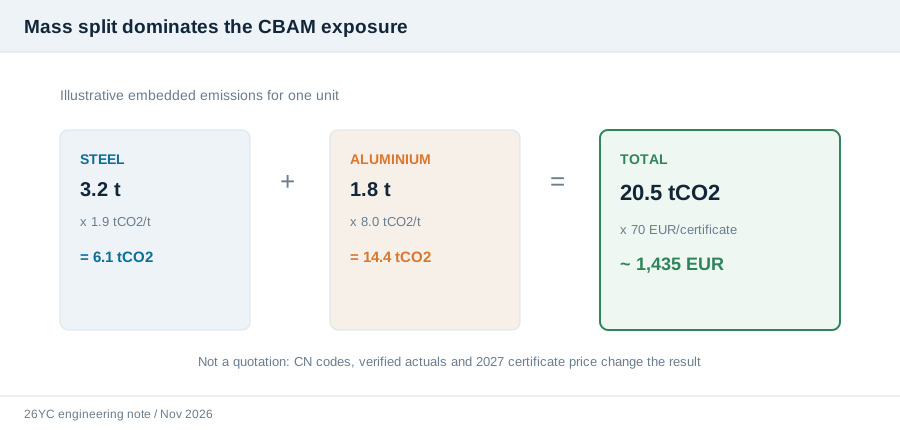
Three things change that answer: the real CN codes, the verified actual values instead of our round intensities, and the certificate price in 2027. We would not put the €1,435 in a contract. We would put the mass split and the verifier’s name in the technical file, because those are the parts under our control.
The distinction we keep having to make
A heat exchanger avoids emissions when installed; it embodies emissions when manufactured. These are separate accounts and should never be netted in a sales deck. Recovery equipment that displaces 300 MWh of gas heat a year is a Scope 1/2 reduction at the customer’s site. CBAM is about the steel and aluminium that left our gate. Our comptabilité carbone pour HVAC et le embodied carbon explainer keep those boundaries apart; the ESG disclosure overview covers where each number is reported.
There is a design consequence worth stating plainly. If aluminium dominates the exposure in the illustrative calculation, then a material substitution or a mass reduction has a compliance dimension in addition to a thermal one. We are not suggesting you redesign a core for CBAM — the guide de selection des materiaux has the real engineering criteria — but a quotation that offers both an aluminium and a steel-cased option should show the mass of each.
What we tell buyers
Ask your supplier for the mass split and the monitoring plan before you ask for a “carbon-neutral” claim. The China vs Europe supplier verification guide has the document checklist, and the 2026 export buyer guide covers the wider commercial picture. If a vendor cannot tell you which facility produced the aluminium, that is a data gap your declarant will fill with a default.
Spécifiez le bon échangeur
Nos ingénieurs dimensionnent le noyau selon votre débit, température et budget de perte de charge, et choisissent la récupération par plaque, rotative ou caloduc selon l'application. Lisez le guide de l'échangeur , ou contactez-nous pour une spécification.
Produits connexes
Récupération par plaque, rotative ou caloduc pour le CVC et la ventilation.
Noyaux stationnaires à grande surface pour l'air et le liquide.
Récupération d'énergie à haute efficacité pour grands débits.
Courants passifs et totalement séparés pour applications propres.