
The 2 K That Decides Whether a Liquid-Cooled Rack Can Feed a Heat Network
Ask a data centre team how much heat they can recover and you will get a megawatt number. Ask what temperature the district heating network returns at, and the room usually goes quiet. The second question is the one that sizes the exchanger.
Direct-to-chip cold plates hand you coolant at roughly 45–55°C in most 2026 deployments. A fourth-generation district network runs about 50–60°C supply and 30–40°C return. Those two ranges nearly touch, which is why the current wave of heat-reuse projects is a liquid-cooling story and not an air-cooling story. Air-cooled halls reject heat at 25–35°C; the lift is so large that the heat pump eats the margin.
Work the arithmetic at the interface
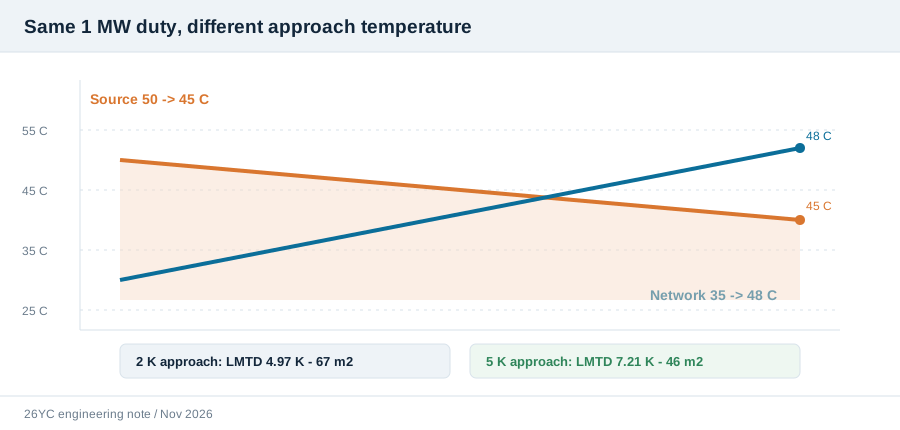
Take a 1 MW recovery duty. Source water arrives at 50°C and leaves at 45°C. Network water comes back at 35°C and we want to deliver 48°C. In counter-flow the terminal differences are 50 – 48 = 2 K at the hot end and 45 – 35 = 10 K at the cold end:
LMTD = (10 – 2) / ln(10 / 2) = 4.97 K. With U = 3,000 W/m2K for a water-to-water plate exchanger, UA = 1,000,000 / 4.97 = 201,000 W/K, so the required area is about 67 m2.
Relax the hot-end approach to 5 K by delivering 45°C instead of 48°C and the LMTD rises to (10 – 5) / ln(10 / 5) = 7.21 K. Area falls to about 46 m2. That is a third of the plate pack, gone, because someone accepted three degrees less on the delivery temperature.
Now put the pump on the balance sheet. At 5 K temperature change on the water side, mass flow is 1,000,000 / (4,180 x 5) = 47.8 kg/s, about 172 m3/h. If each side of the exchanger costs 30 kPa and the pumps run at 70% efficiency, that is 2 x (30,000 x 0.0478 / 0.7) = 4.1 kW, or 0.4% of the recovered duty. Cheap. Which is exactly why we tell clients not to buy a smaller, tighter exchanger to save capital: the fan and pump penalty is not where this project fails.
Where it does fail
The network may not want 48°C in July. A data centre produces heat 8,760 hours a year at an almost flat rate; a heating network absorbs it for perhaps 3,000–4,500 hours, concentrated in winter. A third-generation network with a 60–70°C return is worse than useless here — the return is hotter than the source, so the entire duty has to go through a heat pump with a 30–40 K lift. We have seen feasibility studies that quote a recovered MWh figure without ever stating the network return temperature. We do not accept those studies as a design basis.
Our position, and we have argued it with more than one integrator: the heat purchase agreement should be drafted before the plate exchanger is sized. It fixes delivery temperature, annual offtake hours, and who carries the summer surplus. Only then does the 2 K versus 5 K decision become an engineering trade rather than a guess.
What this means for the air-side equipment
There is still an air-to-air job in these buildings — support spaces, UPS rooms, battery rooms, and the residual air-cooled fraction of the hall. That is where liquid-cooling and immersion waste-heat reuse meets the more mundane pressure-drop calculation for ventilation cores. Keep the two loops separate in the specification. A plate heat exchanger on a 50°C water loop and a cross-flow core on a 30°C exhaust airstream are not interchangeable, and the plate / rotary / heat-pipe comparison applies to the second one only.
If you want the full chain from server coolant to network substation, start with our data centre waste heat recovery guide; the ROI calculator will show how sensitive payback is to the number of hours the heat is actually taken.
適切な熱交換器を選定
当社のエンジニアが風量、温度、圧力損失の予算に合わせてコアを設計し、用途に応じて板式・回転式・ヒートパイプ回収を選定します。以下をお読みください: 熱交換器ガイド 、または仕様についてお問い合わせください。
関連製品
HVAC および換気向けの板式・回転式・ヒートパイプ回収。
空気と液体用の大表面積固定コア。
大風量向け高効率エネルギー回収。
清浄用途向けの受動的・完全分離流。