The 2 K That Decides Whether a Liquid-Cooled Rack Can Feed a Heat Network
Ask a data centre team how much heat they can recover and you will get a megawatt number. Ask what temperature the district heating network returns at, and the room usually goes quiet. The second question is the one that sizes the exchanger.
Direct-to-chip cold plates hand you coolant at roughly 45–55°C in most 2026 deployments. A fourth-generation district network runs about 50–60°C supply and 30–40°C return. Those two ranges nearly touch, which is why the current wave of heat-reuse projects is a liquid-cooling story and not an air-cooling story. Air-cooled halls reject heat at 25–35°C; the lift is so large that the heat pump eats the margin.
Work the arithmetic at the interface
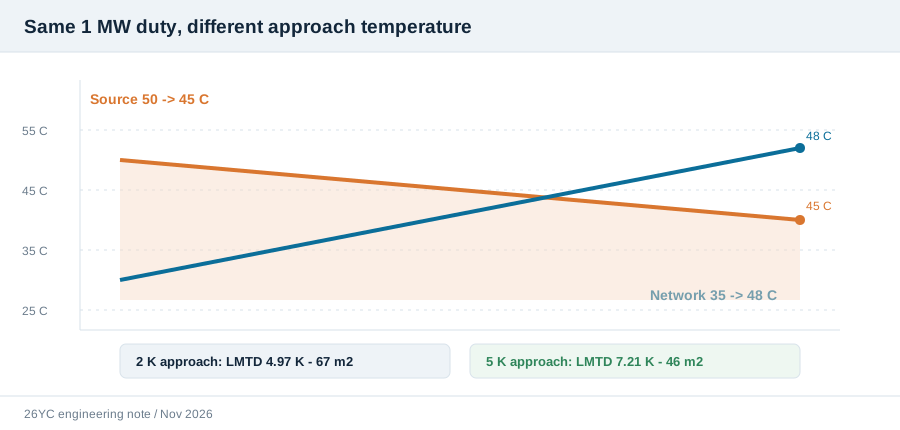
Take a 1 MW recovery duty. Source water arrives at 50°C and leaves at 45°C. Network water comes back at 35°C and we want to deliver 48°C. In counter-flow the terminal differences are 50 – 48 = 2 K at the hot end and 45 – 35 = 10 K at the cold end:
LMTD = (10 – 2) / ln(10 / 2) = 4.97 K. With U = 3,000 W/m2K for a water-to-water plate exchanger, UA = 1,000,000 / 4.97 = 201,000 W/K, so the required area is about 67 m2.
Relax the hot-end approach to 5 K by delivering 45°C instead of 48°C and the LMTD rises to (10 – 5) / ln(10 / 5) = 7.21 K. Area falls to about 46 m2. That is a third of the plate pack, gone, because someone accepted three degrees less on the delivery temperature.
Now put the pump on the balance sheet. At 5 K temperature change on the water side, mass flow is 1,000,000 / (4,180 x 5) = 47.8 kg/s, about 172 m3/h. If each side of the exchanger costs 30 kPa and the pumps run at 70% efficiency, that is 2 x (30,000 x 0.0478 / 0.7) = 4.1 kW, or 0.4% of the recovered duty. Cheap. Which is exactly why we tell clients not to buy a smaller, tighter exchanger to save capital: the fan and pump penalty is not where this project fails.
Where it does fail
The network may not want 48°C in July. A data centre produces heat 8,760 hours a year at an almost flat rate; a heating network absorbs it for perhaps 3,000–4,500 hours, concentrated in winter. A third-generation network with a 60–70°C return is worse than useless here — the return is hotter than the source, so the entire duty has to go through a heat pump with a 30–40 K lift. We have seen feasibility studies that quote a recovered MWh figure without ever stating the network return temperature. We do not accept those studies as a design basis.
Our position, and we have argued it with more than one integrator: the heat purchase agreement should be drafted before the plate exchanger is sized. It fixes delivery temperature, annual offtake hours, and who carries the summer surplus. Only then does the 2 K versus 5 K decision become an engineering trade rather than a guess.
What this means for the air-side equipment
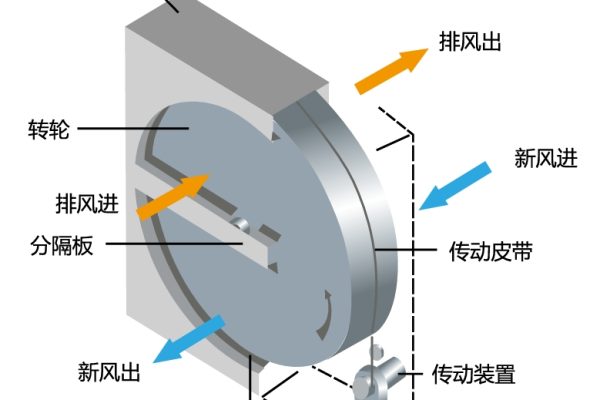
There is still an air-to-air job in these buildings — support spaces, UPS rooms, battery rooms, and the residual air-cooled fraction of the hall. That is where liquid-cooling and immersion waste-heat reuse meets the more mundane pressure-drop calculation for ventilation cores. Keep the two loops separate in the specification. A plate heat exchanger on a 50°C water loop and a cross-flow core on a 30°C exhaust airstream are not interchangeable, and the plate / rotary / heat-pipe comparison applies to the second one only.
If you want the full chain from server coolant to network substation, start with our data centre waste heat recovery guide; the ROI calculator will show how sensitive payback is to the number of hours the heat is actually taken.
적합한 열교환기 선정
당사 엔지니어가 풍량, 온도, 압력 손실 예산에 맞춰 코어를 설계하고, 적용에 따라 판형·회전식·히트파이프 회수를 선택합니다. 다음을 읽으세요: 열교환기 가이드 , 또는 사양 관련 문의를 주세요.
관련 제품
HVAC 및 환기용 판형·회전식·히트파이프 회수.
공기 및 액체용 대면적 고정 코어.
대풍량용 고효율 에너지 회수.
청정 적용을 위한 수동적·완전 분리 유동.