
A Certified Core Inside a Leaky Casing: The Retrofit Loss Nobody Measures
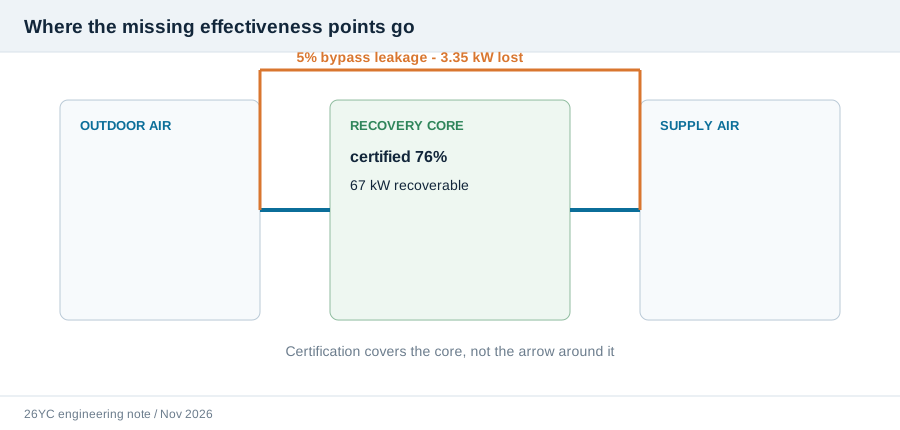
Commissioning data from a 10,000 m3/h AHU last year: the recovery core had a directory-listed 76% sensible effectiveness. The measured seasonal recovery was closer to 68%. The core was fine. The bypass damper did not seal.
This is the quietest failure mode in heat recovery retrofits, because every component passes its own test. Eurovent and AHRI certification rate the core — effectiveness, pressure drop on both sides, carryover for rotary devices — at a declared airflow under EN 308 or AHRI 1060. Neither programme rates the casing, the damper, the duct connections, the filter bypass, or where somebody put the temperature sensors. Those are installation issues, and they are where the missing percentage points go.
Put a number on the leakage
At 10,000 m3/h with a 20 K difference between exhaust and outdoor air, the recoverable duty is (10,000 / 3,600) x 1.2 x 1,005 x 20 = 67 kW. If 5% of the supply air slips past the core through a badly seated bypass damper, roughly 3.35 kW of that duty is lost continuously during heating hours. Over 6,000 operating hours, with a gas boiler at 90% efficiency and heat at €0.06/kWh, that is about €1,340 a year. On one unit. On a campus with twelve AHUs the number stops being a rounding error.
Now add the part that is harder to price: a 5% leak means the control system sees a supply temperature it did not expect, so it trims the wheel speed or opens the bypass further. The control loop chases a fault it cannot diagnose. We have been called to sites where the specified remedy was “replace the wheel”. The remedy was a £40 gasket and an actuator setup.
Our acceptance list for a retrofit
A certified core is worth specifying — it is the only way to compare two vendors’ “80%” claims on the same basis. But we will not sign off a retrofit until these are measured on the assembled unit:
- Face velocity at operating airflow, compared with the rating point in the directory listing. Effectiveness falls as velocity rises; a core rated at 2 m/s does not deliver the same number at 3 m/s.
- Bypass damper leakage, measured rather than assumed, with the damper commanded closed and the fan at design speed.
- Four temperature points — outdoor, supply, return, exhaust — logged for at least a week, with sensors placed far enough downstream to see mixed air rather than a streak.
- Filter fit. A gap around a filter frame is a bypass path that never appears on any test report.
- Pressure drop on both sides, checked against the fan curve. We covered the fan-energy side in pressure drop and fan energy.
The last one matters in older buildings especially. A retrofit adds a core to an AHU whose fans were sized for an empty casing. If the extra 150–200 Pa was never absorbed into a fan upgrade, the airflow drops, the building team opens dampers elsewhere, and the recalculated savings never arrive. Our AHU integration guide 및 step-by-step AHU selection calculation both start from the available fan pressure for that reason.
What we would change about the specification
Write two acceptance clauses instead of one: a factory clause for the certified core, with the directory listing and model number attached; and a site clause for the assembled AHU, with a measured seasonal effectiveness target and a leakage limit on the bypass damper. The second clause is what the building actually buys.
We also ask for the frost-control sequence in writing before the order. A wheel that is certified at +5°C outdoor air tells you nothing about how the unit behaves at -12°C; see frost protection in heat recovery systems 및 defrost strategies for rotary wheels for the control logic we expect to find.
Related: how Eurovent certification works 및 reading a core test report.
적합한 열교환기 선정
당사 엔지니어가 풍량, 온도, 압력 손실 예산에 맞춰 코어를 설계하고, 적용에 따라 판형·회전식·히트파이프 회수를 선택합니다. 다음을 읽으세요: 열교환기 가이드 , 또는 사양 관련 문의를 주세요.
관련 제품
HVAC 및 환기용 판형·회전식·히트파이프 회수.
공기 및 액체용 대면적 고정 코어.
대풍량용 고효율 에너지 회수.
청정 적용을 위한 수동적·완전 분리 유동.