ISO 16890-1 Edition 2 Is at the Printers. Do Not Rewrite Your Filter Schedule Yet.
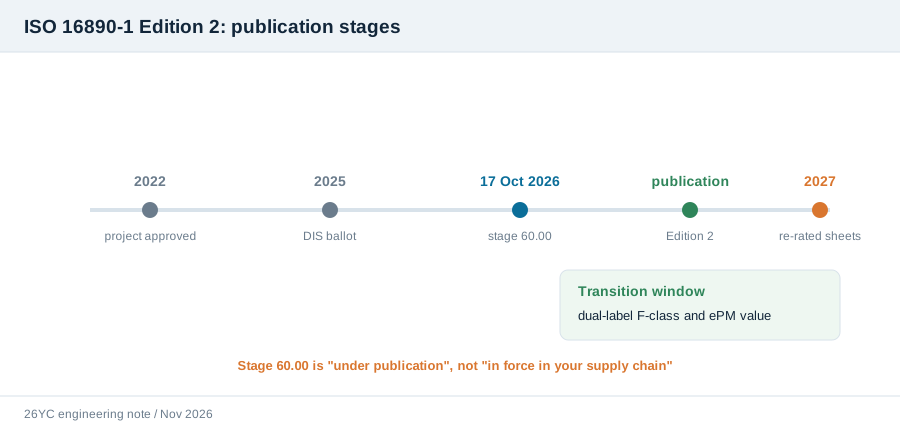
The ISO catalogue moved ISO 16890-1 Edition 2 to stage 60.00 — “International Standard under publication” — on 17 October 2026. It will replace the 2016 edition. That is a real milestone, and it is also the point at which purchasing departments tend to do something unnecessary: delete every F-class from their filter schedule overnight.
Here is what is reasonably settled and what is not. The ePM1 / ePM2.5 / ePM10 classification system survives; the revision tightens test-method detail and draws a cleaner boundary with ISO 29463, which covers the higher-efficiency HEPA/ULPA side. The 2016 text already states, plainly, that laboratory results cannot by themselves predict in-service efficiency or lifetime. That sentence is the most useful line in the standard for a specifier, and it is routinely ignored.
The mapping problem nobody budgets for
EN 779’s G and F classes and ISO 16890’s ePM classes are not a conversion. F7 was a broad bucket defined against a 0.4 µm average synthetic dust efficiency; ePM1 is a fractional efficiency against a defined PM1 aerosol, reported after a conditioning step. Two filters both sold as “F7 equivalent” can land on opposite sides of an ePM1 50% threshold. We have seen schedules where a straight substitution changed the actual particulate protection of a cleanroom make-up air unit without anyone noticing.
| Schedule line (old) | What to ask for during the transition | 이유 |
|---|---|---|
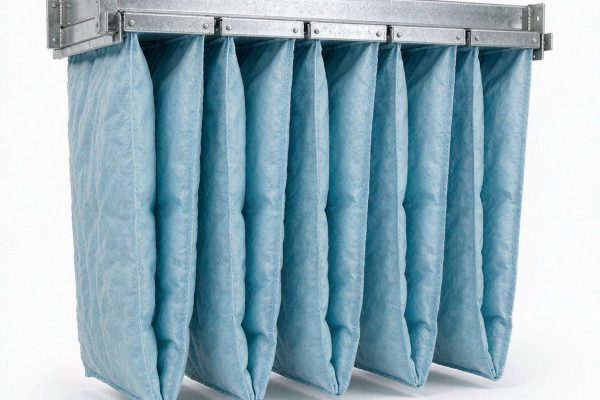
| G4 pre-filter | Coarse grade per ISO 16890 plus a declared initial and final pressure drop | Pre-filters are bought for loading behaviour, not fine-particle efficiency |
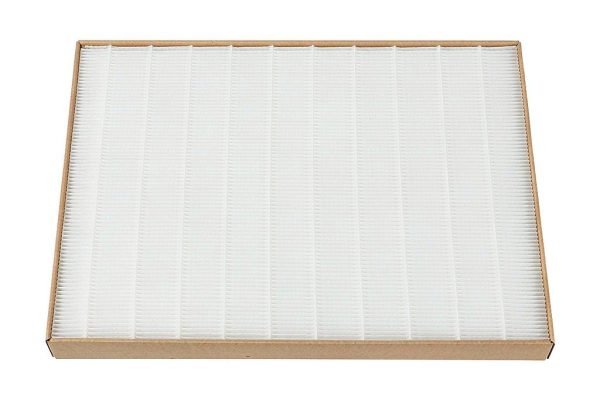
| F7 / F9 medium filter | ePM1 value at the project airflow, with the test report attached | The letter hides the fractional efficiency |
| H13 / H14 HEPA | ISO 29463 or EN 1822 classification and a local leak-scan report | Different standard family, different test |
Our recommendation for the next six months is dull: dual-label. Keep the legacy class in brackets so existing maintenance contracts still make sense, and put the ePM value next to it. Then re-tender on the new basis once the published text and the manufacturers’ re-rated datasheets are both in hand. We would not accept a bid where the vendor has simply crossed out “F7” and typed “ePM1 60%” without a current test report.
The part that actually changes energy use
A filter’s efficiency class does not tell you its pressure drop at your face velocity, and pressure drop is what the fan pays for. At 3,400 m3/h through a single 610 x 610 mm face (0.372 m2), velocity is 2.54 m/s — inside the standard’s test range but at the upper end of what we like to see in a commercial AHU. Split that across two 610 x 610 cells and velocity halves to 1.27 m/s. With a pressure-drop exponent around 1.7 (an empirical figure; measure it, do not quote us on it), a 120 Pa filter would land near 37 Pa. Same media, same efficiency class, roughly a third of the resistance.
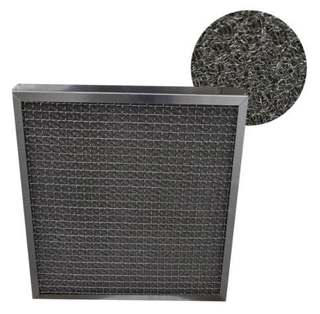
That is why our filter enquiries ask for the rated airflow alongside the class. The three-stage filter comparison 및 pressure-drop and replacement guide go into the maintenance consequences; the efficiency-class explainer is where we keep the legacy-to-ePM mapping.
Where filters meet the recovery core
One reason we care about this on a heat-recovery site: whatever passes the pre-filter ends up on the exhaust face of the core. A cheap pre-filter changed on a calendar instead of on differential pressure can cost more in core cleaning than the entire filter budget. We wrote that calculation out in plate exchanger cleaning and maintenance, and the face velocity explainer shows why the same filter behaves differently at two airflows.
For HEPA stages, the separate question of MPPS and leak testing is covered in HEPA/ULPA selection.
적합한 열교환기 선정
당사 엔지니어가 풍량, 온도, 압력 손실 예산에 맞춰 코어를 설계하고, 적용에 따라 판형·회전식·히트파이프 회수를 선택합니다. 다음을 읽으세요: 열교환기 가이드 , 또는 사양 관련 문의를 주세요.
관련 제품
HVAC 및 환기용 판형·회전식·히트파이프 회수.
공기 및 액체용 대면적 고정 코어.
대풍량용 고효율 에너지 회수.
청정 적용을 위한 수동적·완전 분리 유동.