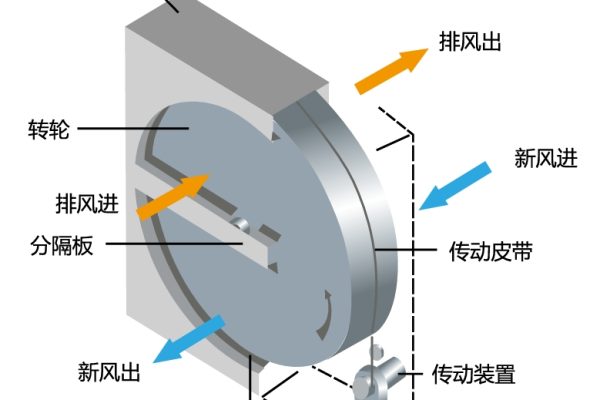
1. Basic Principle of Heat Exchangers
Heat exchanger is equipment that transfers heat between two fluids at different temperatures (air-to-air, air-to-liquid, liquid-to-liquid) through a solid wall or direct contact, without mixing them. It is the core component of a heat-recovery system, widely used in HVAC, power, petrochemical, food drying, and new-energy fields.
2. Comparison of Main Types
1. Plate Heat Exchanger
Built from stacked corrugated plates, it offers high efficiency, small footprint, and easy cleaning, suitable for clean fluids. The stainless-steel plate air-to-air exchanger is commonly used for catalytic combustion (CO/RCO) tail-gas waste-heat recovery — see Stainless Steel Plate Air-to-Air Heat Exchanger in CO/RCO Applications.
2. Shell-and-Tube Heat Exchanger
Composed of a tube bundle and shell, it is pressure- and temperature-resistant, suitable for large-flow liquid-to-liquid exchange. For its structure, refer to How to Distinguish the Tube Side and Shell Side of a Heat Exchanger.
3. Rotary Heat Exchanger
A regenerative wheel rotates continuously, recovering both sensible and latent heat, suitable for large-airflow, high-humidity exhaust; commonly used in fresh-air systems — see Advantages of Rotary Heat-Recovery Exchangers in Large-Airflow Ventilation.
4. Air-to-Air Heat Exchanger
Dedicated to exhaust-to-fresh-air exchange; airflow velocity is a key parameter in selection — refer to What Is a Good Flow Velocity for an Air-to-Air Heat Exchanger?.
5. Microchannel Heat Exchanger
Flat-tube multi-channel structure, compact and efficient, suitable for refrigeration and precise temperature control — see Microchannel Heat Exchanger.
3. How to Select by Operating Conditions
- Fluid properties: Clean gas → plate or rotary; dusty or corrosive flue gas → heat-pipe or stainless-steel anti-corrosion type.
- Temperature and pressure: High temperature and pressure → prefer shell-and-tube.
- Whether humidity recovery is needed: For dehumidification → total-heat rotary.
- Space constraints: Tight site → plate or microchannel.
4. Coordination with Heat-Recovery Systems
A heat exchanger alone only transfers heat; combined with fans, temperature/humidity sensors, and a control system does it form a complete heat-recovery solution. It is recommended to first clarify the recovery goal (preheat fresh air / heat process water / dehumidify), then back-calculate the exchanger type and area, avoiding “over-specification” or insufficient efficiency.
5. Maintenance and Cleaning Points
- Regularly check plates for fouling and clogging; circulate a neutral cleaner for flushing.
- For rotary types, watch seal wear and motor lubrication.
- In low-temperature winter conditions, provide freeze protection and condensate drainage.
6. Frequently Asked Questions (FAQ)
Q: Which is more efficient, plate or shell-and-tube?
A: Under the same conditions, plate has stronger turbulence and a higher heat-transfer coefficient, but shell-and-tube has a wider pressure/temperature range.
Q: What is the typical efficiency of an air-to-air exchanger?
A: With reasonable design it can reach 60%–80%, depending on the airflow ratio and temperature difference.
For more products and solutions, browse the heat-exchanger product category.
常见问题
How do I choose between plate, shell-and-tube, and rotary exchangers?
Pick by fluid type, temperature, pressure, and whether the streams may mix. Plates suit clean liquids and air; shell-and-tube handles high pressure and dirty fluids; rotary wheels suit large air-to-air duties.
When is a plate exchanger the best fit?
For clean fluids, tight footprints, and high heat-transfer area per volume, such as HVAC make-up air, food lines, and catalytic-combustion exhaust recovery. The unit is easily opened for cleaning.
What about rotary regenerative wheels?
They are ideal for very large air-to-air volumes in HVAC and drying, offering high effectiveness, but the rotating matrix means a small carry-over of one stream into the other.
Are there standards to follow?
Yes. Selection should respect relevant HVAC and energy codes plus equipment standards for pressure, materials, and cleanability, especially in food, pharma, and laboratory settings.
相关产品
面向暖通空调与通风的板式、旋转式或热管回收。
空气与液体用大表面积固定芯体。
大风量用高效能量回收。
用于洁净场合的被动、完全分离气流。