
Choose the Heat Customer Before You Choose the Cooler
atNorth’s November 2026 development agreement for SWE04 names one possible customer: the Långsele district network. The same operator’s other projects point somewhere else entirely — a Stockholm district network at SWE01, a Danish utility serving thousands of homes, a Finnish supermarket next to a site, and a greenhouse development at DEN02. Four different customers, four different commercial structures, one common piece of hardware. Retrospectively, the customer was the design decision.
We think most industrial clients should read that list in reverse order of ambition.
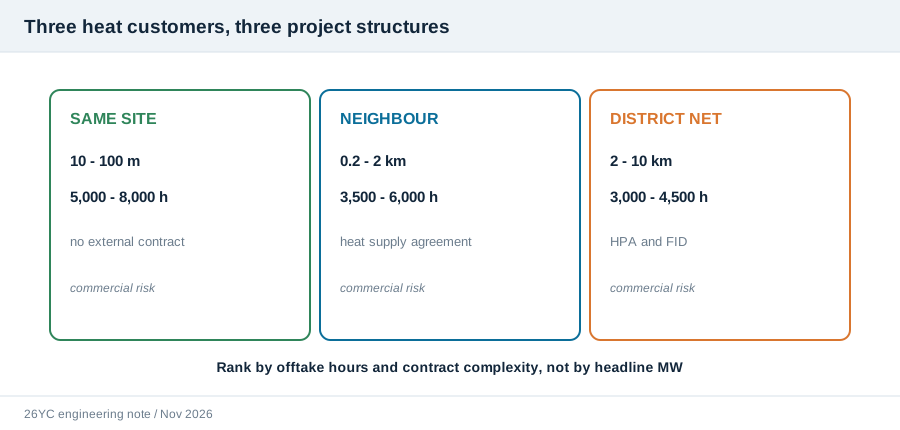
Three sinks, ranked by how quickly they pay
| Heat customer | Typical distance | Usable hours / year | What has to be signed | Our take |
|---|---|---|---|---|
| Same-site make-up air or process preheat | 10–100 m, inside the fence | 5,000–8,000 | Nothing external; an internal control sequence | Start here. Shortest pipe, no counterparty risk. |
| Adjacent greenhouse, supermarket, drying plant | 0.2–2 km | 3,500–6,000 | Simple heat supply agreement, backup arrangement | Best second step where the neighbour exists. |
| Municipal district network | 2–10 km in the Swedish case | 3,000–4,500 | Heat purchase agreement, investment decision, grid connection terms | Real but slow. Budget the civil works and the calendar. |
The first row is the one our clients overlook, because it does not make a press release. A paint shop, a bakery oven, a grain dryer or a cleanroom make-up air unit consumes heat on roughly the same schedule as the process that produces the exhaust. No network return temperature to negotiate, no 10 km trench, no heat purchase agreement due in 2027, no first delivery in 2029. It is an air-to-air core, a duct, and a control sequence.
Why the customer changes the equipment
If the sink is a room, you are specifying a plate, rotary or heat-pipe core against airflow, pressure drop, cross-leakage and frost margin. If the sink is a district network, you are specifying a plate exchanger on a water loop, plus a heat pump sized by the network return temperature, plus a metering point and an isolation bypass. Same word — “heat recovery” — two completely different bills of materials.
There is a hygiene dimension too. When the exhaust carries solvent, grease, dust or pharmaceutical fumes, the receiving stream must stay separated. That is the case for a low-leakage plate core and against a rotary wheel with carryover; we set out the reasoning in pharma and hospital zero-cross-leak applications and in the spray-booth recovery guide. A district network downstream of a contaminated exhaust is not a design we would sign.
A sequence we would actually follow
- Log the exhaust temperature, flow and operating hours for two weeks. Not a design value — a log.
- Walk the site for the nearest heat demand. Inside the fence first.
- Only then look at the network map, and get the return-temperature curve in writing.
- Size the peak duty, then compute annual absorbed MWh against the real offtake hours.
- Put the commercial agreement in front of the equipment order.
Step five is the one we argue about. Equipment lead times are months; heat purchase agreements take longer. Ordering the core first feels productive and frequently produces a plate pack sized for a customer who never signs. Our 投资回收期计算 以及 application selector are the two tools we use before that conversation, not after.
Sector-specific worked examples: cure and industrial ovens, breweries and distilleries, food processing,以及 cleanroom make-up air.
相关产品
面向暖通空调与通风的板式、旋转式或热管回收。
空气与液体用大表面积固定芯体。
大风量用高效能量回收。
用于洁净场合的被动、完全分离气流。