
How We Check the Numbers Before We Publish Them
An editor’s note, not a product page. We publish a lot of engineering content on this site, and in 2026 a growing share of what circulates online about heat recovery is written by other machines. Some of it is confidently wrong. Here is the process we use, including two claims we decided not to repeat in this month’s batch of articles.
The source ladder
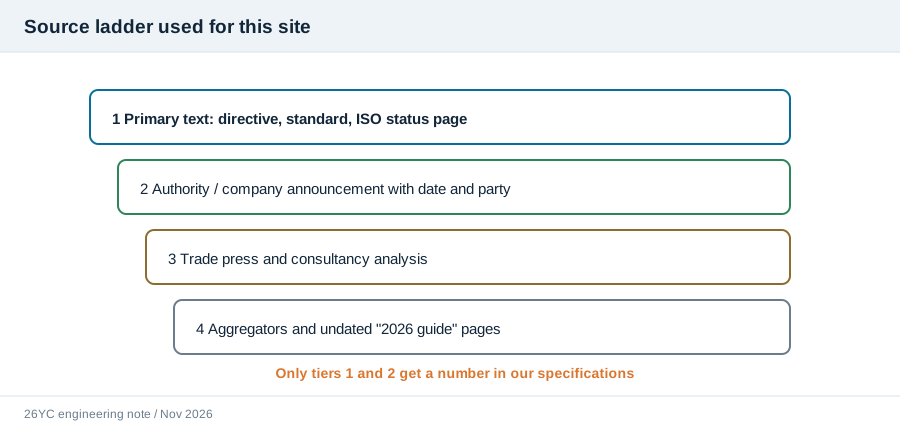
We rank what we read, and the ranking decides what we are willing to put a number on:
- The primary text. A directive, a standard, a regulation, or the issuing body’s own status page. ISO’s catalogue entry showing ISO 16890-1 Edition 2 at stage 60.00 on 17 October 2026 is a fact. A blog saying “the new ISO filter standard is out” is not.
- Company or authority announcements that name a project, a party and a date. A project development agreement signed on 4 November 2026 is real. The heat it will eventually deliver is not yet real.
- Trade press and consultancy analysis, used for context and for finding the primary text, never as the final citation.
- Aggregators and undated “2026 guide” pages. We read them for what the market is talking about. We do not lift numbers from them.
That ladder is why some of our articles say “under publication” instead of “published”, or “development agreement” instead of “supplies heat to 8,000 homes”. The distinction sounds pedantic until it ends up in a tender document.
Two 2026 claims we left out
While researching this month’s batch we met two figures repeated across several sites: a supposed EU requirement for 82% sensible recovery efficiency under EN 308 tied to the recast EPBD, and a supposed 2026 European standard imposing a 2°C cell-temperature-uniformity limit on imported liquid-cooled BESS containers. Both appeared in near-identical wording on multiple domains, neither pointed to a primary text we could open, and one of them described a conformity route we could not reconcile with how CEN standards are adopted.
We left both out. Not because they are necessarily false — we are not the standards body — but because we could not verify them, and an unverified number in a specification is worse than no number. If a reader can send us the official text, we will publish a correction with the exact clause. That has happened before.
Our own corrections
We have changed our minds in public more than once. Earlier this year we described AHRI and Eurovent certification as a compliance requirement. It is not: it is a voluntary certification programme that many public and large private specifications demand. That distinction matters to a buyer writing a tender, and we now say “specify certified performance” rather than “certification is mandatory”. We also revised how we talk about data-centre heat reuse — our earlier writing treated air-cooled halls as a viable recovery source; the temperature grades make that a marketing claim far more often than an engineering one.
Every worked example on this site carries its assumptions next to the arithmetic: airflow, density, specific heat, fan efficiency, operating hours, energy price. If you change the fan efficiency from 0.62 to 0.72, our answer changes and you can see by how much. We would rather show a calculation a reader can disagree with than a conclusion they cannot check.
Why this is on an engineering site
Because a heat exchanger is bought against a specification, and a specification is only as good as the numbers in it. If you are comparing suppliers, our China vs Europe procurement and quality-verification guide et le test-report reading guide are the two pages we would start with. If you find a number on this site that you think is wrong, use the contact page and quote the clause. We answer those.
Spécifiez le bon échangeur
Nos ingénieurs dimensionnent le noyau selon votre débit, température et budget de perte de charge, et choisissent la récupération par plaque, rotative ou caloduc selon l'application. Lisez le guide de l'échangeur , ou contactez-nous pour une spécification.
Produits connexes
Récupération par plaque, rotative ou caloduc pour le CVC et la ventilation.
Noyaux stationnaires à grande surface pour l'air et le liquide.
Récupération d'énergie à haute efficacité pour grands débits.
Courants passifs et totalement séparés pour applications propres.