
GB/T 151-2026 Is in Force. It Does Not Apply to Your Air-to-Air Core.
A purchasing department sent us a specification last month that asked for a 0.8 MPa hydrostatic test on a plate-type air-to-air core rated at 250 Pa. Three suppliers quoted three wildly different prices. Two of them priced a pressure vessel. The third asked, politely, whether anyone had read the scope clause.
The confusion is understandable. China’s revised national standard GB/T 151-2026 Heat Exchangers was published in January 2026 and took effect on 1 August 2026, replacing the 2014 edition. It revises material selection, strength calculation, tubesheet design, tube-bundle grading, manufacturing inspection and — notably — adds energy-efficiency test and evaluation methods for shell-and-tube units. It is the core technical reference for pressure-bearing heat exchangers built or used in China. Buyers noticed. Then they pasted it into every enquiry they had.
Where the scope actually stops
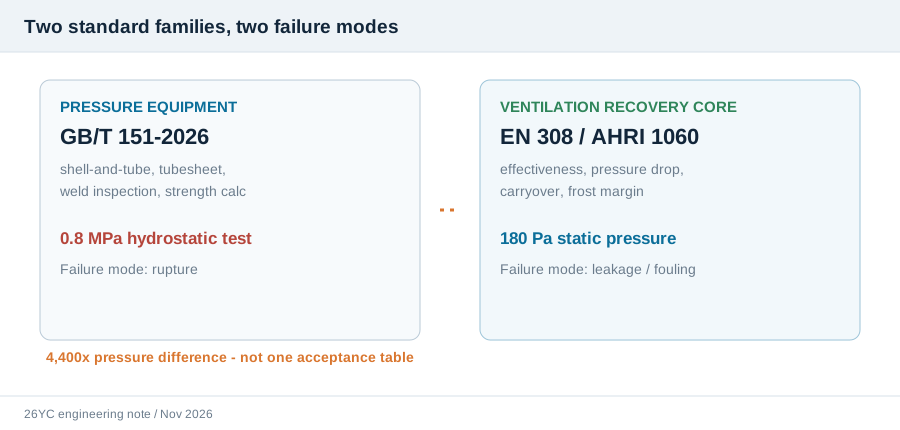
GB/T 151 covers pressure equipment: shell-and-tube and similar vessels where the governing risk is mechanical failure under pressure. A ventilation recovery core is a different object. Its governing risks are air leakage between streams, frost at the exhaust face, pressure drop against a fan curve, and fouling that quietly removes 15% of the duty over two years. There is no design pressure in the vessel sense. Asking for a hydrostatic test tells us nothing about whether the core will survive a -12°C morning.
The difference is not academic. Take a 20,000 m3/h AHU with 180 Pa of core pressure drop. Fan shaft power at 62% efficiency is about (20,000 / 3,600) x 180 / 0.62 = 1.6 kW. The 0.8 MPa figure in that specification is roughly 4,400 times the static pressure the core will ever see. Applying welding-procedure qualification, radiographic examination and tube-expansion pull-out tests to a 0.1 mm aluminium foil stack adds cost and adds no information.
What we put in the specification instead
| Equipment in the package | Standard family to cite | What the test proves |
|---|---|---|
| Shell-and-tube / pressure vessel | GB/T 151-2026, ASME VIII where specified | Mechanical integrity under pressure |
| Air-to-air recovery core, ventilation duty | GB/T 21087, EN 308, AHRI 1060 | Sensible / latent effectiveness, pressure drop, carryover at a declared airflow |
| Microchannel exchanger | GB/T 47194-2026 (effective 1 September 2026) | Construction and rating for compact cores |
| Chemical-process tubular exchanger | HG/T 2650-2026 (effective 1 November 2026) | Non-fired tubular units, p up to 35 MPa |
| Whole AHU | EN 13053 / EN 1886, Eurovent where required | Casing leakage, thermal and acoustic performance of the assembled unit |
Our own rule is boring and it works: the first line of the enquiry states what the package does not contain. If there is a steam coil or a pressure vessel in the same order, it gets a separate section with its own codes and its own acceptance records. The core section then asks for four numbers at the design airflow — effectiveness, pressure drop on both sides, exhaust-air transfer ratio, and the frost-control setpoint. Those are the numbers that decide whether the unit works in February.
One more thing we insist on, and it is not in most templates: the test report must show the airflow and face velocity at which effectiveness was measured. A catalog that says “80%” without a rating point is not a claim we can check. Our guide to reading an air-to-air test report walks through the fields we ask suppliers to fill in, and the EN 308 test method explains why the rating conditions matter more than the headline percentage.
What changed for us in 2026
We used to keep a single “standards” line in our datasheets. After three standards landed in four months — GB/T 151 in August, the microchannel standard in September, HG/T 2650 this month — we split it into a table like the one above. It costs an extra ten minutes per quotation and removes an entire category of dispute at factory acceptance. If you are writing a 2027 specification, do the same before you send it out.
Related on 26YC: verifying CE, AHRI and Eurovent claims, AHRI 1060 rating conditions, and the standards glossary.
Spécifiez le bon échangeur
Nos ingénieurs dimensionnent le noyau selon votre débit, température et budget de perte de charge, et choisissent la récupération par plaque, rotative ou caloduc selon l'application. Lisez le guide de l'échangeur , ou contactez-nous pour une spécification.
Produits connexes
Récupération par plaque, rotative ou caloduc pour le CVC et la ventilation.
Noyaux stationnaires à grande surface pour l'air et le liquide.
Récupération d'énergie à haute efficacité pour grands débits.
Courants passifs et totalement séparés pour applications propres.